Have you ever felt the calm that needlework brings? It’s not just soothing; it also boosts your creative problem-solving skills. Cross stitch, a timeless embroidery art, has been loved for centuries. It offers many benefits that help your mind and heart feel better.
When you work on a cross stitch, you’re making more than just a pretty piece. You’re also sharpening your creative thinking and problem-solving skills. The detailed patterns and exact stitches in cross stitch teach you patience, focus, and how to analyze things well.
Through this traditional craft, you unlock your creative side and find new ways to solve tough problems. As you dive into cross stitch, you’ll see its many advantages. It can lower stress and make your brain work better.
Key Takeaways
- Cross stitch can enhance your creative problem-solving skills.
- Needlework can improve mental and emotional well-being.
- Embroidery hacks and techniques can help you develop patience and attention to detail.
- Cross stitch can reduce stress and improve cognitive function.
- Engaging in traditional crafts can tap into your creative potential.
The Connection Between Needlework and Mental Agility
Needlework, like cross stitch, boosts your mental agility. The detailed patterns challenge your brain, making it more flexible.
The Cognitive Benefits of Crafting
Crafting, such as cross stitch, offers many cognitive benefits. It sharpens focus, concentration, and memory. The soothing motion of stitching can also lower stress and anxiety.
How Manual Activities Stimulate Different Brain Regions
Manual tasks, like needlework, activate various brain areas. This boosts mental agility. It also helps create new brain paths, enhancing thinking skills.
The Mindfulness Aspect of Stitching
Stitching promotes mindfulness, being fully in the moment. This mindfulness reduces stress and boosts mental health. Adding cross stitch to your life can improve your mental state.
Understanding needlework’s link to mental agility reveals its cognitive perks. It can sharpen your mental flexibility and overall well-being.
Understanding CROSS STITCH as a Problem-Solving Tool
Starting a cross stitch project is more than making art. It’s about solving problems too. Cross stitch challenges your mind and boosts your creativity.
The Basic Elements of Cross Stitch Projects
A cross stitch project has a pattern, fabric, thread, and needle. The pattern’s complexity, fabric type, and thread variety affect the challenge. Counted cross stitch patterns, for example, require you to count threads. This sharpens your attention to detail.
How Pattern Reading Develops Analytical Skills
Reading cross stitch patterns sharpens your analytical skills. You learn to understand symbols, color changes, and stitch counts. This improves your ability to analyze and make decisions. Complex patterns enhance your critical thinking for life.
Planning and Organization Skills Developed Through Stitching
Cross stitch projects need planning and organization. You must set up your workspace, manage materials, and track your progress. Good cross stitch organization is essential for success.
Setting Up Your Project Workspace
A dedicated workspace for cross stitch helps you stay organized. Make sure it’s well-lit and free from distractions. Organize your threads, needles, and supplies for easy access.
Managing Materials and Supplies
Effective material management is crucial for a successful project. Keep threads organized by color and type. Use the right needles and fabric for your project. A well-organized supply system saves time and reduces frustration.
| Material | Tips for Management |
|---|---|
| Threads | Organize by color and type, use thread conditioners to prevent tangling |
| Needles | Store in a needle case, use the correct size for your fabric |
| Fabric | Keep it clean and stretched, use a hoop or frame for stability |
Common Cross Stitch Challenges and Their Solutions
Cross stitch can be tricky, with problems like knots, tangles, and counting mistakes. But, with the right approach, you can solve these issues. You’ll need patience, creativity, and sometimes, a bit of problem-solving.
Dealing with Knots and Tangles
Knots and tangles can be really frustrating. To avoid them, use a needle threader to guide the DMC floss through the needle. Keeping your thread short can also help prevent tangles. If a knot appears, try to work it out with your needle or use a cross stitch tool for the job.
Recovering from Counting Errors
Counting mistakes can be tough, especially in detailed patterns. To fix it, re-count the stitches around the error. Use a stitch marker to mark your spot. If the mistake is big, it’s okay to rip it out and start again.
Adapting When You Run Out of Materials
Running out of floss can slow you down. Always check your supplies before starting. If you’re missing a color, you can find a similar shade or order more. For beginner cross stitch projects, it’s smart to buy extra floss to avoid running out.
Troubleshooting Tension Issues
Tension problems can mess up your cross stitch. If your stitches are too tight, the fabric might pucker. If they’re too loose, they might look sloppy. To fix this, adjust your stitch tension as you go. Using a hoop can help keep your stitches even. Practicing on scrap fabric can also improve your technique.
Developing Spatial Reasoning Through Stitching
Working on cross-stitch projects boosts your spatial reasoning. This is because stitching presents many cognitive challenges. For example, you must translate two-dimensional patterns onto fabric.
Reading and Translating Patterns to Fabric
Reading a cross-stitch pattern is more than following steps. It’s about understanding a visual language. You learn how the pattern’s grid matches the fabric’s weave, making adjustments as needed. This improves your ability to see and move objects in space.
Understanding Color Theory and Substitutions
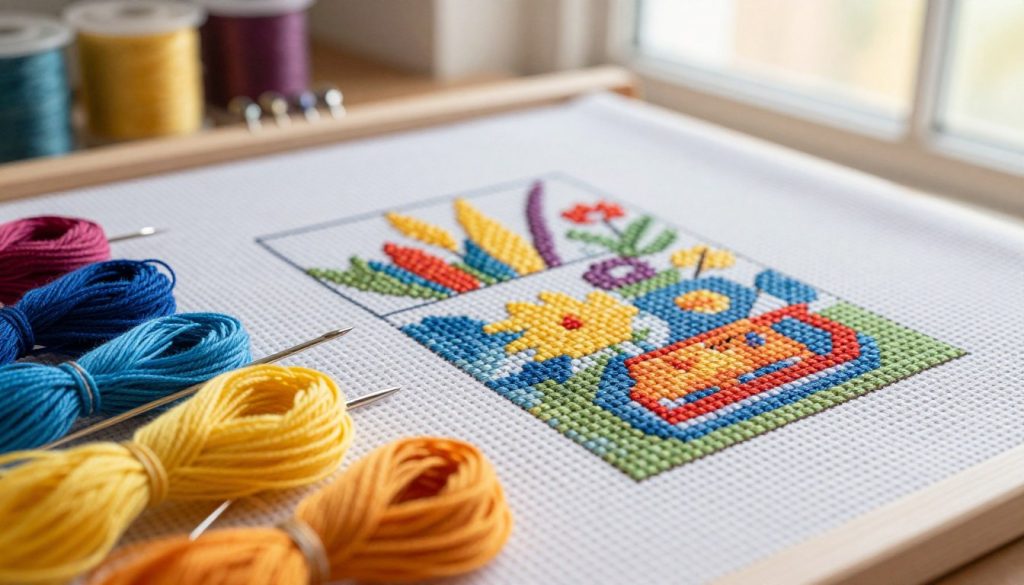
Color theory is key in cross-stitch, as it greatly affects your work’s look. You must think about how colors work together and when to swap them due to availability or preference.
Creating Depth with Color Variations
Different shades and tints can add depth to your stitching. By picking colors wisely, you can make parts of your design seem closer or farther away. This adds depth to your work.
Problem Solving with Limited Floss Options
At times, you might not have the exact color needed. This forces you to be creative and find a good substitute. It helps you develop problem-solving skills.
Gridding Techniques for Complex Patterns
For detailed designs, using a grid on your fabric is very helpful. It makes stitching more precise and helps with complex patterns. This boosts your spatial reasoning.
| Gridding Technique | Benefit |
|---|---|
| Dividing fabric into sections | Improves accuracy in stitching |
| Using a grid overlay | Helps in managing complex patterns |
| Counting threads | Enhances precision and control |
By mastering these cross-stitch skills, you’ll not only make beautiful pieces. You’ll also improve your spatial reasoning and problem-solving skills in many areas of life.
Creative Adaptations: Making the Pattern Your Own
Making a cross stitch pattern your own is a mix of creativity and skill. As you get better, you’ll want to add your own touches to patterns or make new ones.
Customizing Existing Patterns
Customizing patterns is a great first step. You can change colors, modify designs, or adjust sizes. For example, you might update old patterns with new colors or make complex designs simpler for beginners.
Troubleshooting Design Challenges
Customizing or creating designs can bring challenges. You might need to fix color changes or adjust designs for your fabric. Troubleshooting these challenges requires creativity and technical skills, like adjusting thread counts or substituting colors.
Creating Original Designs from Scratch
Creating original designs is a rewarding challenge. It involves several steps, like coming up with your design, choosing colors, and turning it into a stitchable pattern.
Converting Images to Cross Stitch Patterns
One way to create original designs is to turn images into patterns. You select an image, simplify it, and then make it into a grid pattern. There are tools available to help make your design look professional.
Calculating Fabric Size and Thread Requirements
After designing, you need to figure out fabric and thread needs. This means knowing stitch count, fabric count, and thread amounts. A table can help organize these calculations:
| Color | Thread Amount | Stitch Count |
|---|---|---|
| Red | 2 skeins | 500 |
| Blue | 1 skein | 200 |
| Green | 3 skeins | 800 |
By doing these calculations, you can make sure you have enough materials without wasting any.
Remember, the journey of making a pattern your own is just as important as the end result. Enjoy experimenting and trying new things.
Transferring Cross Stitch Problem-Solving to Daily Life
Skills from cross stitch, like recognizing patterns and paying attention to details, are useful in many real-life situations. As you work on your cross stitch, you’ll see how these skills help improve your problem-solving. This can make a big difference in your daily life.
Pattern Recognition in Work Scenarios
Being able to spot patterns is a skill that helps a lot in work. It lets you understand complex systems, see challenges coming, and find good solutions. For example, in data analysis, spotting patterns helps you find trends and make smart choices.
Patience and Persistence in Challenging Situations
Cross stitch teaches you to be patient and persistent when things get tough. These traits are key in everyday life, where you’ll face obstacles. Using the patience and persistence from cross stitch helps you handle tough situations better.
Breaking Down Complex Problems into Manageable Steps
One great thing about cross stitch is learning to break down big patterns into smaller steps. This skill is useful in many areas of life, like planning at work or setting personal goals. Breaking tasks into smaller steps helps you make progress and reach your goals.
Developing Attention to Detail and Quality Control
The detail focus needed for cross stitch helps in other parts of your life too. It makes you better at finding mistakes and keeping high standards. Whether it’s a work project or a hobby, the detail focus from cross stitch ensures quality results.
Using the problem-solving skills from cross stitch makes you more efficient and confident in your daily life. As you keep exploring cross stitch, you’ll find more ways to use these skills in other areas. This leads to growth in both your personal and professional life.
Conclusion: Stitching Your Way to Better Problem-Solving Skills
Discovering cross stitch reveals it’s more than a hobby. It’s a way to boost your creative problem-solving skills. By adding cross stitch to your routine, you sharpen your mind and solve complex problems better.
Many people find cross stitch therapy calming yet mentally stimulating. It lets you create something lovely while honing your analytical skills and focus. This hobby is a mix of relaxation and mental challenge.
Using what you learn from cross stitch can help in many life areas. It can make your work better or just give you a fun hobby. So, grab a needle and thread and start improving your problem-solving skills through cross stitch.
 English