Welcome to a practical guide for CROSS STITCH for stitchers in the United States. It’s for both beginners and experienced hobbyists. You’ll find tips to make your stitching faster, more accurate, and enjoyable.
In this article, you’ll discover 10 secrets based on best practices and tools from DMC and Mill Hill. Topics include fabric choice, gridding, floss tricks, needle and tool selection, backstitching, and more. You’ll also learn about fixing mistakes and the mental benefits of stitching.
Struggling with tension? Jump to floss handling and needle selection. Need quick fixes? Go to the embroidery hacks. Looking for inspiration? Check out the creative ideas and seasonal projects. Bookmark this guide and use the tips on your next project.
Key Takeaways
- This guide shares ten practical CROSS STITCH secrets for faster, neater work.
- You’ll learn about fabric, gridding, floss organization, and needle choices.
- Tactics use real-world advice from DMC and common best practices.
- Navigation cues help you jump to tension, fixes, or creative ideas fast.
- Save or bookmark the article to apply tips to your current cross stitch projects.
Unconventional CROSS STITCH foundations for flawless starts
Start strong by treating your material choice as part of the craft, not an afterthought. Good cross stitch foundations set the tone for tension, stitch clarity, and final size. You will save time and frustration if you pick the right base before you touch a needle.
Choosing the right fabric and count for your project
Beginner stitchers often prefer Aida for its clear holes and easy counting. For most starters, choose 11–16 count Aida. Experienced stitchers reach for evenweave or linen when they need fine detail or a softer drape.
Brands such as Zweigart and DMC supply consistent quality across Aida, evenweave, and linen. If you plan two-over-two stitching, try 28–32 count evenweave to keep threads from packing too tightly.
Remember that fabric count changes the finished size and thread usage. Use this quick formula: stitched width = (design stitches ÷ fabric count) + seam allowance. That calculation helps with framing, matting, and deciding needle size.
How gridding saves time and reduces mistakes
Cross stitch gridding cuts counting errors and speeds progress on complex charts. A 10×10 grid that matches pattern blocks gives you visible anchors across the work.
You can grid with a Hera marker, a Sakura water-soluble pen, or loose basting thread in a contrasting color. Each method has benefits. Pencil and erasable markers leave no prick holes. Basting is fast and stays put during long sessions. Water-soluble pens wash away after completion.
When you match your grid to the chart, you will rework fewer sections. Gridding reduces mental load so you can focus on tension and color transitions in counted cross stitch.
Preparing and treating fabric to prevent distortion
Always pre-wash new cross stitch fabric to remove sizing that can resist thread. Use a gentle detergent and cool water. Rinse thoroughly and dry flat.
Press the fabric with a clean press cloth to avoid shine or scorch marks. Test any temporary fabric stiffeners on a scrap before use. Apply stiffeners sparingly and only where tiny trims require extra body.
Protect raw edges with zigzag stitching, masking tape, or Fray Check to stop raveling. For even tension while you stitch, stretch fabric on a frame or hoop. If you use dyed fabric, pre-wash a scrap to confirm colorfastness before committing your DMC or other threads.
Secret floss handling and DMC floss tricks for vibrant color
Before starting your project, adopt a few simple habits. Good floss handling begins with understanding stranded cotton. DMC floss has six strands, split as needed for your project.
For 14–16 count fabric, use two strands. For larger counts or more texture, use three or four strands.
Separate strands carefully. Hold the cut end near your scissors and pull the strands away. Cut with sharp scissors to avoid uneven ends.
Smooth out kinks by running the length between your fingers. Thread Heaven can reduce static and keep tension even.
Separating and organizing DMC floss for consistent tension
Label bobbins with DMC numbers and store them in a plastic organizer or floss box. Use ring-bound cards or apps like Pattern Keeper to track colors. Group skeins by light, mid, and dark shades to speed up work.
Wind each bobbin loosely to avoid memory and shortening the length. Keep working lengths 18–24 inches long. This prevents tangles and keeps tension steady.
Preventing floss fray and keeping colors true
To prevent fraying, cut strands at an angle with sharp scissors. Replace dull needles often and use tapestry needles with a blunt point. Stitch from shortest to longest length to avoid dragging and wear.
Test colorfastness before starting a project. Wash small scraps in mild detergent and dry them away from sunlight. Sunlight can mute colors over time, so store finished pieces away from hot windows.
Making small color adjustments without recharting
If a shade feels off, blend two strands on the needle for an intermediate tone. Try one strand of a brighter DMC floss with one strand of a muted neighbor to tone down vibrancy. You can also add a single-strand highlight or lowlight to soften transitions without recharting.
Substitute the nearest DMC shades when needed and test on a scrap. Fractional stitches, tiny backstitch accents, or a single blended stitch in a key area can shift mood and depth. For example, adding a brown strand to a bright red produced a warmer, vintage look without redrawing the pattern.
Needle selection and cross stitch tools you didn’t know you needed
Upgrading your stitching is easy with the right choices. Choose needles and tools that make stitching easier and protect your fabric. The right tools help you stitch longer, cleaner, and with less strain.
Comparing needle types for counted work and specialty threads
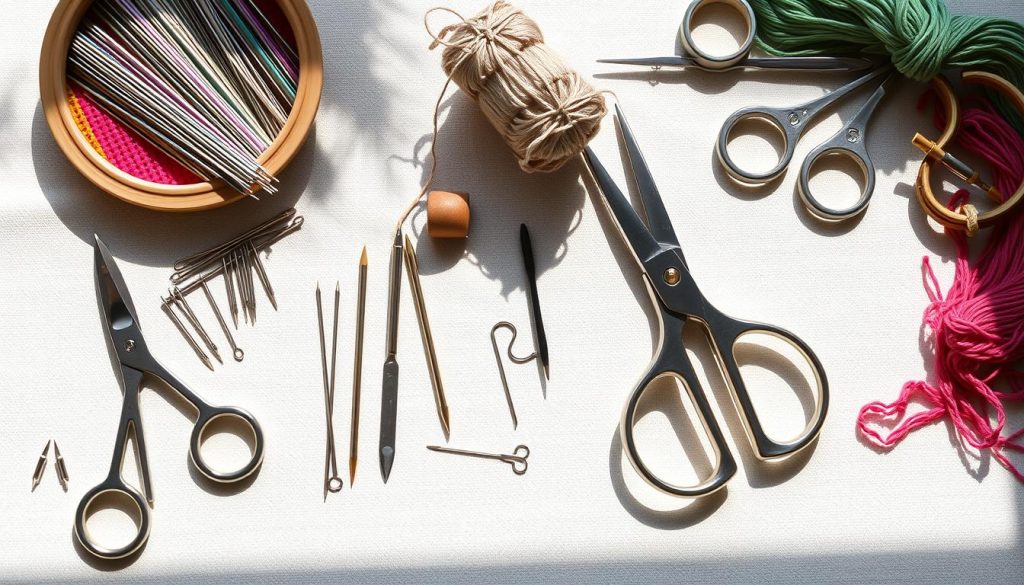
For counted cross stitch, use tapestry needles with blunt tips in sizes 24–28. These needles move smoothly between Aida and evenweave threads without splitting them. Brands like Bohin, Milward, and John James offer reliable tapestry needles.
Sharps are best for metallic threads. They have a finer point and a larger eye, making them perfect for metallics. Milliners and crewel needles are great for long, straight stitches and some surface embroidery. They help keep tension even for threads like silk or wool.
Must-have tools: frames, hoops, magnifiers, and lighting
Choose cross stitch frames based on your project size. Q-snap frames are good for large pieces because they offer steady tension. Scroll frames keep fabric flat and even, which is great for long sessions. Wooden or plastic hoops are handy for small projects and touch-ups.
Good lighting and magnifiers make tiny stitches easier. LED daylight lamps reduce eye fatigue. A Magnifying Visor or a floor lamp with an adjustable arm improves visibility when you move between colors. For travel, clip-on lights and portable magnifiers keep work readable on the go.
Creative tool hacks for faster stitching and better posture
Simple hacks can change your comfort and speed. Use a foam wrist rest or a small pillow to support your hands while stitching. Convert a tablet or phone stand into a pattern holder so you keep your head up and eyes forward.
Binder clips hold fabric taut on scrolls or frames. A pendant light or headlamp focuses illumination where you work. Rotate the project periodically instead of bending wrists repeatedly. Sit with feet flat and elbows supported to avoid strain. Take short micro-breaks to prevent hand fatigue.
| Tool | Best for | Recommended Brands or Types | Why it helps |
|---|---|---|---|
| Needles (tapestry 24–28) | Counted cross stitch on Aida/evenweave | Bohin, John James, Milward | Blunt tip prevents splitting and maintains fabric integrity |
| Sharp and metallic needles | Metallic threads and specialty fibers | John James sharps, needles with larger eye | Shorter shaft and larger eye reduce fray and ease threading |
| Q-snap / scroll frames | Large projects and even tension | Plastic Q-snap, wooden scroll frames | Keeps fabric flat; reduces distortion over time |
| Hoops (wood/plastic) | Small to medium pieces | Traditional wooden hoops, lightweight plastic | Portable and quick to set up for short sessions |
| Magnifiers and lighting | Close work, low-light stitching | LED daylight lamps, Magnifying Visor, clip-on lights | Improves contrast; reduces eye strain and mistakes |
| Accessories (snippers, scissors) | Trimming and tidy finishes | Gingher scissors, thread snippers, needle minders | Precise cuts and safe needle storage speed workflow |
| Ergonomic aids | Posture and comfort | Foam wrist rests, pillow supports, binder clips | Reduces repetitive strain and keeps stitching steady |
Backstitching techniques that make your pattern pop
Backstitching brings life and definition to cross stitch patterns. It turns simple shapes into eye-catching motifs. Making small changes can greatly enhance the look of your embroidery.
Timing your backstitch for maximum impact
You can backstitch as you go, in sections, or at the end. Stitching as you go prevents distortion and catches errors early. It helps maintain the shape of your design.
Stitching at the end keeps your work smooth and prevents snagging. Stitching in sections offers a balance between progress and finishing tasks.
Techniques for smooth lines and even spacing
Use one continuous length of floss for long outlines to avoid visible joins. Keep your tension even to prevent fabric puckering. This ensures your backstitches lie flat.
Work with shorter lengths to avoid twist. On curves, try split stitch alternatives or small diagonal stitches. Align each backstitch centrally on the grid line for a balanced look.
For sharp corners, pivot by anchoring the thread discreetly behind the work. Use tiny diagonal stitches for a clean turn. On higher-count fabrics, single-strand backstitching keeps lines fine for intricate detail.
Combining backstitch with specialty stitches for texture
Layer backstitch over metallic or silk accents to define shapes without overwhelming shine. Pair backstitch with French knots, detached chain stitches, or long stitches to add depth.
Use Kreinik metallic threads with a thread conditioner and a Milliner needle for smoother handling. For florals, outline petals with cross stitch backstitch and place a few French knots at centers for a polished finish.
Finish tidy by trimming and securing thread tails on the back with small securing stitches. This keeps the reverse neat for framing or gifting and preserves the integrity of the piece.
Cross stitch organization methods to streamline projects
Good systems keep your work moving and your supplies usable. Use clear storage habits to prevent lost threads, misplaced patterns, and stalled projects. The steps below make it easier to start, pause, and finish pieces without chaos.
Labeling and storing patterns and threads efficiently
Keep a printed copy and a working copy of each chart. Slip the original into a plastic sleeve or binder to protect it. Use a marked-up working sheet for notes, color swaps, and progress marks.
Use color-coded tabs for active projects so you can grab one and go. Scan paper charts with a mobile camera app and store PDFs in Evernote or Google Drive for searchable access. That lets you find patterns fast when inspiration strikes.
Using project bags, bobbins, and digital tools
Wind DMC floss onto plastic bobbins and write the DMC number on each bobbin. Store bobbins in multi-compartment boxes from Clover or DMC organizers to avoid tangles. For project-specific sets, place labeled bobbins in zip-top bags.
Choose compact project bags for portability. Small zip pouches or drawstring project bags hold fabric, needle, and labeled floss for a single project. For larger work, use a stitcher’s tote like the DMC Smart Bag or a project tray to keep everything together.
Adopt digital tools for easier chart management. Use Pattern Keeper on Android to track progress, PCStitch to edit charts, and Cross Stitch Saga to organize patterns. Maintain a simple spreadsheet to track UFOs and floss inventory so you never buy duplicates.
Maintaining a stitching schedule to finish projects faster
Set micro-goals for steady progress. Commit to 15–30 minute sessions each day to keep momentum without burnout. Time-block stitching into your routine and use a timer or habit app to stay consistent.
Track milestones like finishing a motif or 50 stitches to measure progress. Batch similar tasks together, such as completing all backstitching in one session, to save time and maintain focus. These small habits help you complete projects faster and enjoy the process more.
Embroidery hacks to fix common cross stitch mistakes
Small errors happen to every stitcher. This quick guide gives practical embroidery hacks to rescue a project without stress. Read each tip, use a steady light, and keep patience at hand.
How to safely unpick cross stitch
- Work from the back when possible. Use a small stitch ripper or the point of a sharp sewing needle to lift stitches gently.
- Cut central threads in tiny sections instead of yanking a whole run. This keeps holes small and fabric stable.
- Remove short fluff by teasing it out with tweezers. Take breaks to avoid rushed pulls that enlarge holes.
Repairing pulled fabric and uneven tension issues
- To fix puckering, re-stretch the piece on a frame or hoop. Gently manipulate nearby threads to even the tension.
- For severe pulls, soak in lukewarm water, press flat between towels, then block to shape on a padded surface.
- Use extra caution with metallic threads and specialty fibers; treat them gently to prevent fraying and distortion.
When to frog cross stitch versus when to patch or disguise mistakes
- Define frog cross stitch as ripping out stitches to correct layout or color. Choose frogging for large misplacements that change composition.
- If the error is small or in a busy area, consider patching with applique, overlaying a motif, or hiding the flaw with beads or extra stitches.
- Make your decision based on project size, time invested, visual impact, and whether you plan to frame the piece.
Correcting counting errors
- Identify a single wrong column or row and remove only that area. This saves time and preserves surrounding work.
- If you make frequent counting mistakes, re-grid the fabric and use temporary basting to realign larger sections.
- Compare surrounding motifs to pattern anchors like borders or focal points to spot miscounts quickly.
Preventive embroidery hacks
- Keep a strong light source and a needle minder to reduce dropped stitches and miscounts.
- Check grid lines regularly so small cross stitch mistakes stay small and easy to fix.
- When tension problems recur, pause and reassess your floss thickness, needle size, and hand position.
If you need to remove errors, follow the safe unpicking steps and then focus on repairing tension so the fabric looks smooth. Those two moves solve many common issues without resorting to drastic measures like full frogging every time.
Creative cross stitch ideas and patterns for inspiration
Begin with a clear plan to make a pattern personal. Choose a central motif, like a floral spray or a pet portrait. Then, decide on the final object, such as a pillow, ornament, tea towel, or framed art.
Resize a chart by counting stitches across the motif and matching it to your fabric. For pillows and tea towels, add 1 to 2 inches of seam allowance. For ornaments, crop tightly and add a decorative border. Use DMC backstitch in a contrasting color for names, dates, or short quotes.
Try free monogram charts or use classic fonts like Times New Roman or Courier as guides. Crop a larger chart to focus on a single element for quick wins. Recolor small areas using blended flosses to soften tones.
Use negative space for minimalist designs that read well from a distance. Find charts in community patterns and marketplaces like Etsy and 123Stitch. Also, check designer websites for paid and free options.
Mix counted work with fabric appliqué and textile paint for bold backgrounds. Apply a lightweight fabric square to your base with temporary spray adhesive, then stitch through it for secure edges. When adding beads or sequins, stitch them down with a small backstitch or a seed bead loop to prevent snagging.
For painted backgrounds, fix colors with textile medium and allow full curing before stitching. Combine cross stitch with embroidery stitches like French knots, satin stitch, and chain stitch to add texture. Use beads at focal points to catch light.
For longevity, tack appliqué pieces with a narrow zigzag machine stitch or hand-sew them with matching thread. Then, finish raw edges with a satin stitch or small blanket stitch.
Quick, themed cross stitch projects make great gifts and practice. Try a 4–8 hour mini-project like a Halloween sampler, holiday ornament, floral bookmark, pet portrait key fob, or a housewarming motif on a tea towel. These projects fit into busy schedules and boost your sense of progress.
When adapting patterns for gifts, think about personalization beyond names. Add birthdates, coordinates, or a short nickname in a tiny font. Use blended flosses to create subtle shading on faces and fur in pet portraits.
For home decor, repeat a small motif in a grid to form a modern, framed triptych.
For mixed-media embroidery, choose adhesives rated for textiles and test on scraps. Use a fine needle with a strong polyester thread when stitching through multiple layers. Secure beads with a small knot and a dab of fray-block along the thread tail when working on frequently handled items.
Find fresh cross stitch patterns and inspiration in magazines, on Instagram using #crossstitch and #embroideryinspiration, and by following designers whose work you admire. Community groups on social platforms offer real-world tips and pattern swaps that spark new cross stitch ideas.
Cross stitch therapy and the mental benefits of needlework
Stitching helps you focus quietly and reset. It improves concentration, lowers stress, and creates a calming rhythm. By following charts, you also sharpen your visual skills and attention.
How stitching improves focus, patience, and relaxation
Repeating simple motions improves focus. This repetition reduces anxiety by focusing on a tactile task. Short sessions build patience, and finishing small projects boosts confidence.
Using small projects as mindfulness exercises
Begin with 15-minute sessions to calm your mind. Try stitching with your breath: inhale for two, exhale for two. Small projects like mandalas or 50×50 motifs are perfect for quick wins and staying present.
Community, inspiration, and sharing your progress online
Stitching connects you with others who share your passion. Join Facebook groups, Ravelry boards, or Reddit’s /r/CrossStitch to share tips and celebrate. Post your work on Instagram for inspiration and join SALs for support.
Practical tips for mental health and safety
Listen to audiobooks, calming music, or guided meditations while stitching. Set achievable goals to avoid feeling overwhelmed. View unfinished projects as learning experiences, not failures. Completing and framing your work boosts your confidence.
Ergonomics to protect your well-being
Good lighting, a supportive chair, and breaks prevent strain. Use magnifiers or daylight lamps when needed. Adjusting your posture keeps your sessions enjoyable and safe.
Conclusion
You’ve learned the key cross stitch techniques that will change how you start and finish projects. From picking the right fabric and gridding to using DMC floss and needles, these tips reduce mistakes and save time. Tools like Q-snap frames also help.
Practical embroidery hacks, like organizing floss by number and backstitching quickly, make your work look better. These tips help you create cleaner, more professional pieces.
Try one tip this week, like gridding a piece, organizing threads, or using a new frame. Short practice sessions will help you master the technique and finish projects faster. Small changes can make a big difference in how much you enjoy stitching.
Keep learning and connect with others to keep improving. Follow brands like DMC and Zweigart, try apps like Pattern Keeper or PCStitch, and join stitching groups online. Use these tips to improve your needlework and share with others to inspire more finished projects.
 English