
A small change in my needle made a big difference in my cross stitch. It reduced split floss, eased tension, and made long projects enjoyable. This simple switch turned hours of work into steady progress, rekindling my love for cross stitch.
This guide offers practical tips for both beginners and experienced stitchers. You’ll learn how to pick needles that protect fabric and prevent floss from fraying. You’ll also discover how to avoid eye strain when working on detailed or dark fabrics.
Many stitchers face issues like poor tension, snagged fabric, and constant re-threading. These problems often stem from using the wrong needle. By changing to the right needle and using better lighting and stitching methods, these problems can be quickly solved.
This guide explains why the needle is crucial, how to identify needle-related issues, and which needles to try. You’ll learn how to test needles with DMC floss and sample fabric. Plus, you’ll get tips on maintaining your needles and strategies for working with confetti-heavy patterns, dark fabrics, and neat backstitching.
Key Takeaways
- The right needle improves stitch quality and reduces split floss.
- Needle choice affects fabric integrity and overall tension control.
- Combine needle changes with lighting and magnification for dark fabrics.
- Test needles with DMC floss on sample fabric before starting big projects.
- Techniques like parking and cross-country stitching pair well with better needle control.
Why the Right Needle Matters for Your Cross Stitch
Choosing the right needle is key to every stitch. When you pick the right needle for your fabric and floss, your stitches even out. The wrong needle can lead to tugging, frayed threads, and extra work fixing uneven stitches.
How needle choice affects stitch quality and tension
The size and shape of a needle affect how it moves through fabric. A blunt tapestry needle helps you stitch without cutting threads, keeping your tension steady. But, a very fine needle might make you pull too hard, causing tight stitches.
Before starting, test needles on a scrap of your fabric. This helps you see if the needle makes neat stitches or pulls too tight. Make this a part of your cross stitch routine.
Needle impact on fabric integrity and hole size
Tapestry needles have blunt tips that don’t damage the fabric. Sharp needles, on the other hand, can enlarge holes and weaken the fabric. For high-count linens, use micro or fine tapestry needles to keep the weave intact.
Big holes can ruin the clarity of your finished piece. Choose needles that match your fabric’s count to keep it strong and your project durable.
Common needle-related cross stitch mistakes and how to avoid them
Splitting floss is a common mistake. It happens when the needle eye is rough or too small. Replace needles with rough edges and choose the right size for your floss.
Snagging and fabric damage come from dull or bent needles. If you feel resistance or see rough pulls, change the needle. This simple step prevents damage and keeps your work clean.
Uneven tension often comes from the wrong needle and floss combination. Stitch a small swatch to find the right needle size. This helps you avoid mistakes in areas with lots of stitching.
| Issue | Cause | Quick Fix |
|---|---|---|
| Frayed DMC floss | Narrow eye, burrs, or rough point | Use smooth-eyed tapestry needle; replace when burrs appear |
| Loose, gaping holes | Needle too large for fabric count | Downgrade needle size; test on scrap fabric |
| Puckered stitches | Needle too fine or pulling too hard | Use slightly larger tapestry needle; relax tension |
| Snags and pulls | Dull, bent, or damaged needle | Inspect and replace needle; keep backups in a tin |
| Difficulty with confetti areas | Poor needle choice for technique | Choose needle that eases frequent thread changes; practice cross stitch techniques on sample blocks |
Recognizing Problems That Signal a Needle Change Is Needed
You might not see a tired needle at first. Small problems can lead to many mistakes. Spotting them early saves time and keeps your work looking good.
Signs of eye strain or difficulty seeing holes (and lighting solutions)
If you squint, lean in, or get headaches on dark fabrics, it could be the needle or light. Try an OttLite-style task lamp or an LED headlamp. Also, test magnifying reading glasses with a swatch of your fabric.
Place a white cloth behind dark fabric to improve contrast. A lightbox under your project can help see holes without straining your eyes. These changes make stitching easier and faster.
When floss tangles, splits, or drags — needle-related causes
Splitting or fraying strands often mean the needle eye has burrs or rough edges. A polished, larger eye makes floss flow smoother. This reduces splits, especially with stranded DMC floss.
Long thread lengths can cause tangles, even with good needles. Use the right needle and shorter threads. Also, comb your floss and keep your stitching area organized to avoid knots and dragging threads.
Fabric wear, snagging, and how needle condition contributes
Bent or dull needles lead to rough pulls, causing fuzz and big holes. If snagging increases, change the needle before fabric damage is permanent.
For high-count evenweave, use a smaller, smooth tapestry needle to lessen fabric wear. Use smart cross stitch gridding and counting pins to avoid rework and protect your fabric.
Types of Needles and When to Use Them for Cross Stitch
Choosing the right cross stitch needles is key to a great project. A quick test on scrap fabric with your DMC floss can save time and avoid damage. Here’s how to pick the best needle for your project.
Tapestry needles or embroidery needles: pick by need
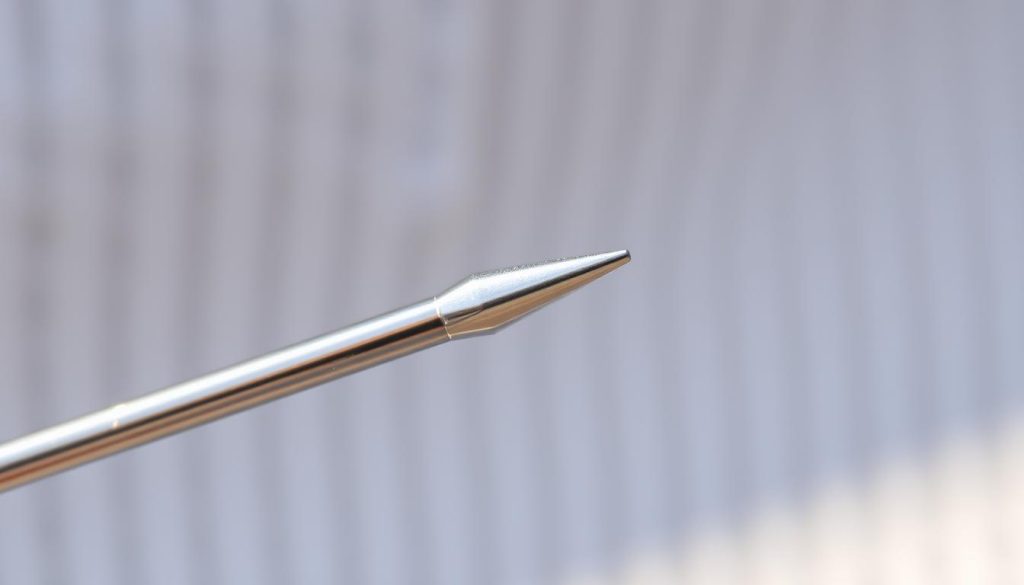
For counted patterns on Aida or evenweave, use a tapestry needle. It has a blunt tip and a big eye. This helps it slide between threads without piercing them, keeping the weave intact.
For surface work and crewel projects, embroidery needles are better. They have a sharp point and a smaller eye. This lets you pierce the fabric cleanly for details and backstitching. But, avoid sharp embroidery needles for most counted cross stitch unless it calls for surface stitches.
Needle sizes for various fabric counts
Choose the right needle size for your fabric count to avoid fiber stress. For low-count Aida (11–14 count), sizes 22–24 tapestry needles are good. For medium counts like 16–18 and common evenweave, sizes 24–26 work well.
For high-count evenweave or linen (28–32 count and up), sizes 26–28 or micro tapestry needles are best. These finer needles help keep the fabric tight and even. Always test your needle and floss on a swatch before starting a big project.
Specialty needles and when to use them
Ballpoint or rounded needles are rare in counted cross stitch but useful for fragile weaves. They move through gaps instead of cutting threads. Keep them in your cross stitch tools box for delicate fabrics.
Sharp needles are great for backstitching and fractional stitches where you need to go through threads. Micro and super-fine tapestry needles are best in confetti-heavy areas and very high-count fabrics. They reduce fabric stress, snagging, and make thread management easier.
When dealing with intense color changes or patterns with many single-thread colors, the right needle helps manage threads and prevents fabric damage. Test different needle, floss, and fabric combinations to find the perfect balance for your project.
How I Chose the Needle That Transformed My Work
Choosing the right needle is key for your project and comfort. I started by testing needles with the same fabric and threads. This helped me see how each needle performed.
Testing needle sizes with DMC floss and sample fabric
Make a swatch with the fabric and DMC floss your project needs. Stitch with different needle sizes. Notice how the fabric looks and feels.
Keep a log of your findings. Note the needle size, how it feels, and any issues with the floss. This helps for future projects.
Balancing needle eye size to reduce floss fraying and splits
Test the eye size with the floss you’ll use. Two strands are different from three. A larger eye reduces fraying.
Choose the smallest eye that works well. This keeps your stitches even and protects the floss.
Practical trial techniques: short sessions, magnification, and lighting
Test needles in short sessions to avoid eye strain. Ten to twenty minutes is enough to judge.
Use good light and a magnifier. Bright light shows frays and thread issues. Test starting and ending threads to see how the needle handles.
| Test Step | What to Observe | Why It Matters |
|---|---|---|
| Swatch with project fabric | Stitch tension, hole size, fabric distortion | Shows real-world needle effect on finished look |
| Vary needle sizes | Frequency of floss splits, smoothness through weave | Identifies best size for DMC floss and count |
| Eye-size test with strand counts | Ease of passing 2 vs 3 strands, fraying | Finds smallest functional eye to balance control and wear |
| Short timed sessions | Comfort, hand fatigue, visibility issues | Predicts long-term usability for larger projects |
| Magnification and lighting | Hidden frays, snag points, thread management | Helps simulate confetti-heavy areas and complex patterns |
| Stitch starts/finishes | How the needle handles knotless starts, parking | Ensures compatibility with your preferred cross stitch tips |
Technique Adjustments After Changing Needles
Switching needles changes how your stitches look and feel. Adjusting your grip and posture can save time and prevent uneven tension. Practice on a sampler before tackling complex patterns to get a feel for it.
Adapting your stitch tension and hand positioning
Finer needles make stitching smoother. You need to relax your grip and avoid pulling too hard. Take a few stitches and check the back for even tension.
If your needle is longer or has a higher eye, adjust your finger placement. This helps keep your movements short and precise.
Start with short sessions to avoid getting tired. A steady wrist and small motions help create clean crosses and prevent fabric distortion in counted designs.
Combining methods like cross-country stitching, parking, and 10×10 blocks
Choose the right method for each area you stitch. Use cross-country stitching in sparse color areas to speed up. In areas with lots of colors, park threads and work in short runs to avoid fraying.
For areas with big color changes, stitch in 10×10 blocks or columns. This keeps colors separate and prevents gaps that block needle access. Mark threads and completed sections to quickly find misplaced shades.
Starting and finishing threads cleanly with a new needle
Test your new needle with thread starts and ends before starting a big project. Short floss lengths help keep tension even and prevent tangles. Use knotless methods for a flat finish that doesn’t bulk the fabric.
When starting, keep the hook close to the fabric to avoid snags. Improved needle handling, counting pins, and good lighting make parking threads easier and reduce mistakes in complex patterns.
Needle Change Benefits for Confetti-Heavy and Complex Patterns
Switching to a finer, polished tapestry needle makes a big difference. It gives you better control when stitching confetti patterns. You can move between tight stitches without making holes or snags.
This smooth action also protects your fabric. It keeps your stitches neat and tidy on detailed patterns.
Having a needle that slides easily is a big plus. It lets you pick out single stitches without catching other threads. You can gently pull the floss near its exit point and guide the needle to free a single strand.
This saves time and prevents frayed ends. It’s especially useful when colors appear only once or twice in a block.
Using a finer needle also makes cross-country stitching easier. If you have enough floss left and it’s used nearby, you can carry the thread across. This reduces the need to start and end tiny bits of floss.
This approach also cuts down on clutter in your work area. It’s great for sparse colors.
A smooth eye and the right needle size lower the risk of mistakes. You’re less likely to split floss or misplace parked threads. This means fewer shading errors later on.
Marking parked threads on your chart helps too. It lets you spot any mistakes early.
When many similar shades are in a section, using a needle that slides free is key. It prevents tangles and keeps colors straight. Use tools like a small threader or needle minder to keep things tidy.
Try out a new needle on a swatch before using it on a big confetti area. See how it handles single-stitch colors, cross-country passes, and retrieving parked threads. Making small changes now can save you hours and keep your project flowing smoothly.
Tools and Workspace Tweaks to Maximize Your Needle Choice
Small changes can make a big difference when you switch needles. Use task lighting, a magnifier, tidy thread organization, and reliable hardware. These tweaks focus on comfort, accuracy, and speed for longer stitching with less strain.
Lighting and magnification strategies for working on dark fabrics
Start with layered lighting: a bright LED task lamp above your work and a clip-on lamp for angled fill. OttLite-style bulbs cut glare and make colors truer. Try a jeweler’s headlamp or an optivisor for hands-free magnification for tight stitches.
Test magnifier strengths on a fabric swatch before committing. Place a white cloth behind dark fabric to boost contrast and reduce eye strain. Choose magnification for cross stitch that lets you read the weave without over-magnifying, which can blur details.
Counting pins, frames, and organization to complement needle efficiency
Use counting pins to mark grids and hold your place in confetti-heavy areas. Pins save time and reduce frogs by preventing miscounts during long sessions. Drop a pin at key points so you can close a frame and resume without hunting for your row.
Choose cross stitch frames that keep fabric tension even and prevent distortion as you stitch. When you grid the fabric, cross stitch gridding aligns with parking methods to cut mistakes. A tidy work surface, with labeled thread boxes, speeds selection and keeps your needle workflow smooth.
Keeping floss manageable: combing, short lengths, and thread management
Cut floss into short lengths to prevent tangles and reduce wear on the needle eye. Comb strands with a small thread comb or your fingers before threading to lower splits and frays. Store colors on labeled bobbins for quick access during complex patterns.
When you park threads, note parked colors on the pattern and comb parked areas periodically to stop knotting. If a color gets tight, hook a strand with your needle near its exit point to free one thread cleanly. Good thread habits keep your needle moving and your stitches tidy.
Putting it together
Combine these cross stitch tools and workspace tweaks with your chosen needle to reduce eye fatigue and speed stitching. Rotate between projects when a dark or dense piece becomes tiring. With proper magnification for cross stitch, effective cross stitch gridding, counting pins, and stable cross stitch frames, your needle choice will deliver better results faster.
Needle Maintenance and When to Replace Needles
Keeping your needles in good shape is simple and protects your fabric. Regular care prevents snagging and floss splits. A quick habit like wiping needles after use can save a lot of time.
Signs a needle is dull, bent, or causing fabric damage
Look out for snagging, floss splits, and rough pulls. These signs mean your needle might be dull or bent. If your stitches start to shift or look uneven, check the needle for damage.
Fabric fuzzing, new holes, or tension problems mean your needle is damaging the fabric. Catching these signs early helps you replace needles before fabric damage is permanent.
Cleaning and storing needles to extend usefulness
Wipe needles with a soft cloth after each use to remove oils and fibers. For a deeper clean, use mild soap and water, then dry them to prevent rust. This keeps your needles sharp and points clear.
Store needles in magnetic cases or labeled containers. Keep tapestry and sharp needles apart to avoid confusion. Organizing your tools by size and type makes it easier to find the right needle.
How often to rotate needles for heavy or long-term projects
If you stitch daily or work on big projects, change needles every few weeks or when they show wear. Less frequent stitchers should replace needles every few months or when performance drops. Regular rotation protects your fabric from unnecessary damage.
Keep backups in sizes for different tasks. Match rotation to your workload and fabric sensitivity to keep your stitching consistent and long-lasting.
| Issue Observed | Likely Cause | Quick Action |
|---|---|---|
| Frequent floss splits | Burr or rough eye | Inspect needle; wipe and smooth or replace needles |
| Uneven stitch placement | Bent shaft | Swap to a straight needle and check previous rows |
| Fabric fuzzing or new holes | Dull point | Replace needle and avoid heavy pulls |
| Rust or residue on needle | Lack of cleaning | Clean with mild soap, dry, then store in magnetic case |
| Loss of smooth glide | Accumulated oils and fibers | Wipe after sessions; keep spare cross stitch tools at hand |
Needle Selection Tips for Beginners and Advanced Stitchers
Choosing the right needle can change how your project feels and looks. For beginners, the right tools make learning easier. For experts, a small change can make backstitching faster and patterns more detailed.
Beginner recommendations
Start with medium-size tapestry needles, like size 24 or 26, for counted patterns on 14–16 count Aida. Blunt points prevent thread splitting and protect fabric. Use short DMC floss lengths and a bright lamp for even tension and neat stitches.
Needles for detail and lines
For lines, use a sharp embroidery needle or a finer tapestry needle. This choice enhances backstitching and gives clearer outlines. Many stitchers use a micro sharp for details and a fine tapestry for main fields.
Matching needle, floss, and fabric
Choose a needle eye that matches your floss strands. For two strands of DMC floss, the eye should fit without squeezing. Use thinner needles for higher-count fabric to avoid large holes. Test on a swatch: if floss frays, try a polished eye or a different brand; if holes look widened, switch to a finer point.
Practical pairing tips
- For beginners: start with 14–16 count Aida, size 24 tapestry needle, two strands of DMC floss, and short sessions.
- For mixed-technique designs: use a sharp needle for backstitching and a blunt tapestry for cross fields.
- When testing patterns: use a small swatch and try different methods to see how needle choice affects speed and errors.
Keep your workspace bright and organized. Proper lighting, counting pins, and small thread lengths reduce fatigue. This makes both beginner and advanced stitching more enjoyable.
Conclusion
Changing your needle can make a big difference in your CROSS STITCH work. You’ll see cleaner stitches and less fabric wear. It also helps with patterns and dark fabrics, making stitching easier.
Match your needle to your fabric and floss. Testing needles on a swatch is a good idea. Use magnification and good lighting to see how they work.
Use tools like counting pins and gridding to avoid mistakes. Short thread lengths and rotating needles help keep your stitches even. This makes stitching more comfortable.
Take care of your needles and replace them when needed. Clean and store them right. This keeps your floss flowing smoothly.
With the right needle and workspace, stitching becomes faster and more fun. You’ll finish projects that look great. Keep trying new things and see how small changes can make a big difference.
 English