
Choosing the right materials is key after picking your first cross stitch pattern. You might feel lost with so many options: Aida, evenweave, or linen; DMC floss numbers like 310 and 321; and needle sizes such as 24 or 26. Start simple to enjoy stitching without stress.
Begin with a basic starter kit. It should include 14-count Aida cloth, the DMC floss your pattern calls for, a size 24 tapestry needle, an embroidery hoop, and small scissors. Make sure your fabric is a bit larger than your design to frame it later. This kit covers most beginner needs and helps you avoid spending too much as you learn.
Tapestry needles are special because of their blunt tip and large eye. They protect Aida’s threads and prevent floss from splitting. Most are nickel-plated, but if you’re allergic to nickel, look for gold-plated options for comfort and durability.
Choose fabric that matches your technique and thread. Cross stitch works best with evenweave fabrics because they have uniform threads and predictable stitch counts. Other styles might need plain weave fabrics or coarse canvases. Pick fabric that fits your pattern and embellishments to avoid frustration.
Key Takeaways
- Choose a simple starter kit: 14-count Aida, DMC floss, size 24 tapestry needle, hoop, and scissors.
- Cut fabric several inches larger than the design for framing and finishing.
- Tapestry needles have blunt tips and large eyes to prevent thread splitting and fabric damage.
- Evenweave and Aida are best for counted cross stitch; match fabric to your technique.
- Stick to basic supplies at first and build a stash over time as you try new cross stitch projects.
Choosing the Right Fabric for Cross Stitch Projects
Choosing the right fabric is key to your cross stitch project’s look and feel. It affects how clear your stitches are, how easy it is to count, and how the fabric drape. The right fabric choice saves time and prevents frustration, especially when following counted cross stitch patterns.
Why fabric choice matters for your cross stitch results
Fabric choice impacts how visible the weave is and how colors appear. It also affects how the needle moves through the fabric. Choose a fabric count that matches your pattern’s demands for crisp details.
If you plan to add beads or sequins, pick a sturdy weave. This ensures the embellishments stay in place without distorting the fabric.
Aida cloth explained: counts, colors, and beginner benefits
Aida is perfect for beginners because its holes are easy to see and count. It comes in various counts like 11, 14, 16, and 18. The 14-count Aida is a good middle ground for many patterns.
Colors range from white and cream to dyed tones that match your design. Fabrics are made from cotton, linen blends, and synthetic materials. Aida’s stiffness helps beginners learn tension and stitch placement.
Evenweave and linen: when to try finer fabrics and what to expect
Evenweave and linen have a finer grid, ideal for detailed work and Hardanger. They require more practice to count due to smaller holes. Linen adds natural slubs and irregularities for a unique look.
Start with Aida and then move to evenweave or linen. You’ll notice a softer drape and smoother finish for advanced projects.
Alternative fabrics: fiddler’s cloth, Jobelan, canvas, and muslin
Fiddler’s cloth has a rustic texture and is heavier than Aida. It’s great for folk-style motifs and projects that don’t need a hoop. Jobelan blends cotton and rayon for a soft sheen, perfect for linens and home decor.
Canvas and Penelope mesh are used in needlepoint but work for embellished cross stitch with heavier threads or beads. Muslin is cheap and good for practice, transfers, or freestyle embroidery where accuracy isn’t crucial.
How to size and cut your fabric for framing and finishing
Always add extra inches on every side before cutting. This makes framing, mounting on hoops, and finishing easier. The border allowance depends on how you plan to finish the piece.
Use a sharp rotary cutter or scissors for clean edges. Treat raw edges with Fray Check, a zigzag stitch, or a serged finish for laundering or long storage. Match needle size and floss weight to your fabric’s weave to protect holes and maintain stitch quality.
Cross stitch tips: start with 14-count Aida, follow pattern count guidelines, and switch to evenweave or linen once counting feels natural.
Understanding Floss Types and Selecting DMC and Alternatives
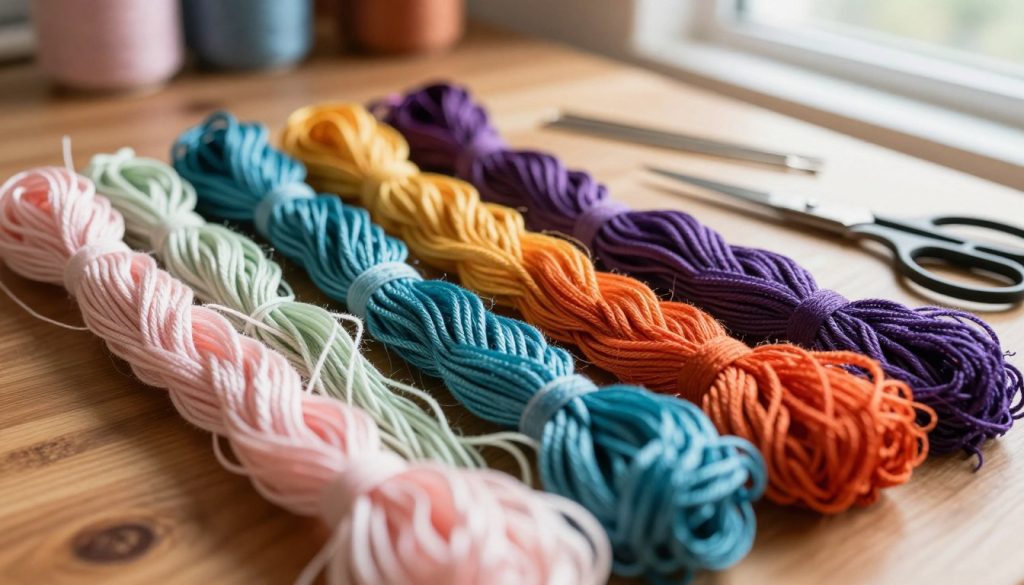
You want thread that brings your designs to life. Most stitchers choose smooth, stranded cotton. This can be split for different fabrics and needles.
DMC floss basics
DMC is a favorite for many because its numbers match patterns. Each skein is about eight meters long, perfect for many projects. Numbers like 310 for black and 321 for red make following patterns easy. You can split DMC strands for different fabrics and needles.
Anchor, Cosmo, and when to choose alternatives
Anchor and Cosmo are great alternatives to DMC. Cosmo feels silky, perfect for satin areas. Anchor is consistent in Europe and has wide availability. Always compare color charts before swapping brands to keep colors true.
Specialty threads: variegated, metallic, hand-dyed
Variegated threads add depth without extra stitching. But, color changes can be tricky in big areas. Metallics add sparkle but can wear needles down. Hand-dyed threads offer unique colors but can vary by dye lot. Use them for small details after you get better with standard floss.
Practical floss handling tips
Cut threads to 18 inches to avoid tangles and wear. Use beeswax or thread conditioner to tame static and fray. Label skeins and store them to make color changes easier. Compare swatches under your work lighting to match colors across brands.
Quick planning checklist
- Default to DMC floss for counted cross stitch patterns for consistent results.
- Reserve specialty threads for highlights and embellishments only.
- Keep skeins organized by number to simplify multi-color projects.
- Follow cross stitch tips like shorter lengths and conditioning to protect fibers.
| Thread Type | Best Use | Pros | Cons |
|---|---|---|---|
| DMC stranded cotton | All-purpose counted projects | Wide color range, consistent dyes, numbered for patterns | Standard finish may lack sheen some prefer |
| Cosmo stranded cotton | Smooth coverage, detailed work | Silky finish, good color matching to DMC | Less common in some regions |
| Anchor stranded cotton | Substitute for DMC in many charts | Durable, easy to find in Europe | Color codes differ from DMC |
| Variegated threads | Shading effects and texture | Instant depth, no blending needed | Unpredictable color flow across patterns |
| Metallic threads | Accents and sparkle | High shine, eye-catching | Abrasive, can fray and split easily |
| Hand-dyed threads | Unique, artisanal pieces | Rich, complex color shifts | Lot variation; may not match charts |
Picking the Best Needles for Your Stitching Comfort and Fabric
Choosing the right needle changes how your work looks and feels. A good selection keeps tension even, reduces thread wear, and makes basic stitches easier. Start with a small range and upgrade as your projects demand.
What makes a tapestry needle different
A tapestry needle has a blunt tip that slides between fabric threads. This blunt tip prevents fabric and thread from splitting. The large eye fits multiple strands, making threading faster.
Needle size guide matched to fabric count
Needle sizes work inversely: a larger number means a thinner needle. Use size 22 for large-holed fabrics like 11-count Aida. Size 24 suits 14-count Aida. Size 26 fits 16-count Aida and 32-count evenweave. Size 28 is for finer fabrics such as 18-count Aida and higher-count linen.
| Fabric Count | Common Needle Size | Why it works |
|---|---|---|
| 11-count Aida | 22 | Larger eye and thicker shaft fill holes without widening them |
| 14-count Aida | 24 | Balances easy threading with minimal hole enlargement |
| 16-count Aida / 32 evenweave | 26 | Fits tighter weave while reducing floss abrasion |
| 18-count Aida / 28–36 evenweave or linen | 28 | Thin shaft avoids forcing holes wider on delicate fabric |
Material and finish: nickel-plated, gold-plated, and ergonomic options
Most needles are nickel-plated. They offer good strength and smoothness for everyday stitching. Gold-plated needles suit stitchers with nickel sensitivity and can glide a bit smoother. Ergonomic needles with larger eyes or special grips reduce hand fatigue during long sessions.
How needle choice affects thread wear, fabric holes, and stitch quality
Using a needle that is too large widens holes so stitches may not cover the fabric. Too-small needles add friction and rub the floss, causing fraying. The right needle minimizes splitting, keeps stitches neat, and helps preserve fabric edges for framing.
- Carry a simple set of tapestry needles in sizes 22–28 for most projects.
- Replace bent or blunted needles to avoid uneven tension and damage.
- Match needle choice to specific cross stitch techniques, such as surface backstitching or working with specialty threads.
CROSS STITCH Tools and Accessories to Improve Your Experience
Choosing the right tools and accessories makes stitching easier and more fun. A few smart items can save time, protect your work, and support the calming focus of cross stitch therapy.
Hoops and frames: keeping fabric taut and preventing distortion
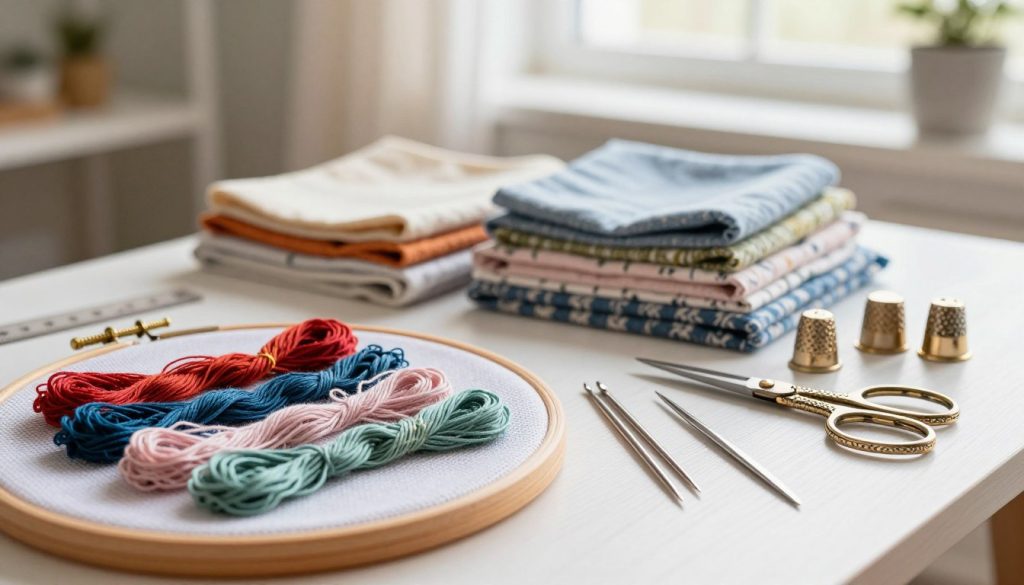
Choose an embroidery hoop that’s a bit bigger than your design. A hoop keeps fabric tight, ensuring stitches are even and fabric doesn’t pucker. For big projects, use stretcher bars or a scroll frame to keep everything flat.
Heavy fabrics like fiddler’s cloth might not need a hoop, but beginners often find frames helpful. Frames keep tension consistent, reducing rework and giving a neater finish.
Needle minders, small scissors, and thread organizers for better workflow
Magnetic needle minders keep your needle safe and prevent lost pins. Small, sharp embroidery scissors make clean cuts for trimming threads.
Label bobbins with DMC numbers and store them in a compact thread organizer. Good cross stitch organization speeds up stitching, prevents tangles, and makes color changes smoother.
Lighting, magnifiers, and storage for longer, more comfortable sessions
Use a daylight lamp or an adjustable LED to reduce eye strain and show true colors. A clip-on magnifier helps with high-count fabrics or tiny details.
Store floss in sealed boxes or zip bags to prevent dust and fading. Keep active projects in a pouch so tools, threads, and patterns stay together for relaxed stitching.
Starter kit checklist for beginner cross stitch projects
Start with 14-count Aida, DMC floss as needed, and a pack of tapestry needles sized 22–26. Add an embroidery hoop, small scissors, and a basic pattern to begin.
Consider extras like a needle minder, thread organizer, a good lamp, and a magnifier. These small additions improve comfort and speed, enhancing the meditative benefits of cross stitch therapy.
Practical Techniques, Common Mistakes, and Embroidery Hacks
Start with a quick overview of smart habits that save time and keep your project tidy. Use short floss lengths, anchor securely, and grid the fabric before you stitch. These simple steps reduce common errors and make your work more enjoyable.
How to start and secure your floss to avoid knots and wasted thread
Begin with methods that suit your comfort. Try a waste knot for small projects, a loop start for even numbers of strands, or tiny anchoring stitches on the back for a clean finish. Keep floss at about 18 inches to limit tangles and fray.
Counting, outlining, and finishing tips
Accurate counting is central to success on Aida and evenweave. Find the pattern center or mark an easy corner, then work outward using grid lines you drew with a water-soluble pen. For outlines, use consistent backstitching techniques and consider a single strand or thinner thread when detail might overfill crosses.
Common beginner cross stitch mistakes and how to fix them
Miscounting and wrong placement are frequent issues. If you spot an error, frog carefully. Use fine scissors or a seam ripper, remove stitches from the back, and re-count before re-stitching. Avoid long floss lengths that knot and prevent splitting fabric threads by choosing the right needle size.
Embroidery hacks for neat tension, gridding, and efficient color changes
Grid your fabric to match pattern squares to cut down on counting errors and speed large fills. Use bobbins or a floss organizer labeled by DMC number to make color swaps fast. Apply a thread conditioner for slippery or hand-dyed threads and keep a needle minder or small dish handy for tools.
Practice even tension by relaxing your hands and using a consistent pull-through motion. Avoid tugging too tight; uniform stitches keep fabric flat and the finished piece balanced. These small adjustments address the most common cross stitch mistakes and improve stitch quality fast.
| Problem | Quick Fix | Tool or Tip |
|---|---|---|
| Miscounted rows | Frog to the last correct row, re-count before resuming | Water-soluble marker for temporary grid |
| Knots and tangles | Use shorter floss lengths and loop start when possible | 18-inch floss length, floss organizer |
| Uneven tension | Practice relaxed hand position and consistent pull-through | Hoop or frame to keep fabric taut |
| Backstitch looks bulky | Switch to a single strand or thinner thread for outlines | Tapestry needle and fine stranded thread |
| Removing mistakes | Work from the back, cut close to fabric, and pull threads out gently | Fine scissors or seam ripper |
Choosing Materials for Specific Projects and Styles
Choose materials that fit your project and style for the best results. Making small decisions early saves time and keeps your stitches neat. This guide helps you pick fabric, needles, threads, and tools for common cross stitch projects. Your work will look as good as you imagined.
Matching fabric count and needle size to counted cross stitch patterns
Use the fabric count recommended by the pattern. Here’s a needle guide: 11‑count Aida with size 22 needles; 14‑count with size 24; 16‑count with size 26; 18‑count and finer with size 28. This prevents gaps and wear on threads and fabric.
Selecting floss and specialty threads for detailed or embellished pieces
Save metallics, variegated, and hand‑dyed threads for special areas. Use them for focal points and accents. For beads or sequins, pick fabric and needles that fit those embellishments. Canvas is good for designs with lots of embellishments.
Considerations for framed work, ornaments, samplers, and gift projects
For framed work, add extra margins for stretching and mounting. Use stable evenweave or stiff Aida for clean edges in cross stitch frames. Ornaments need small seams and a sturdy backing. Samplers look best on linen or evenweave for that traditional feel.
Cross stitch organization and planning for multi-color or large designs
Grid your fabric before starting and sort floss by DMC number. Label pattern pages and mark your progress to avoid mistakes. Break big designs into smaller parts and use a scroll or lap frame to work on one area at a time.
Keep track of specialty threads and plan for substitutes if DMC colors are hard to find. Good organization makes stitching faster and less frustrating. It lets you try new cross stitch ideas for gifts or art.
Conclusion
Begin with simple steps for cross stitch beginners. Choose 14-count Aida, DMC floss, a size 24 tapestry needle, a hoop, small scissors, and good lighting. These basics help you focus on stitches and tension without extra trouble.
Follow the cross stitch tips here to avoid common mistakes. Use shorter floss lengths, the right needle size, and gridding to build confidence fast.
As you learn, notice how fabric weave, count, needle size, and thread work together. Switching from Aida to evenweave or linen changes your stitches and pattern reading. Try different fabrics like Fiddler’s Cloth, Jobelan, canvas, or muslin after mastering basic techniques.
Get the right tools: needle minders, thread organizers, bright task lighting, and a reliable frame or hoop. Practice backstitching, counting, and finishing techniques. Use embroidery hacks for even tension and color changes. These habits help you progress faster and make cross stitch therapy more enjoyable.
With a starter kit and this article’s guidance, your projects will grow. Gather your supplies, thread your needle, and enjoy this hobby. It offers steady embroidery inspiration and a fulfilling creative outlet.
 English