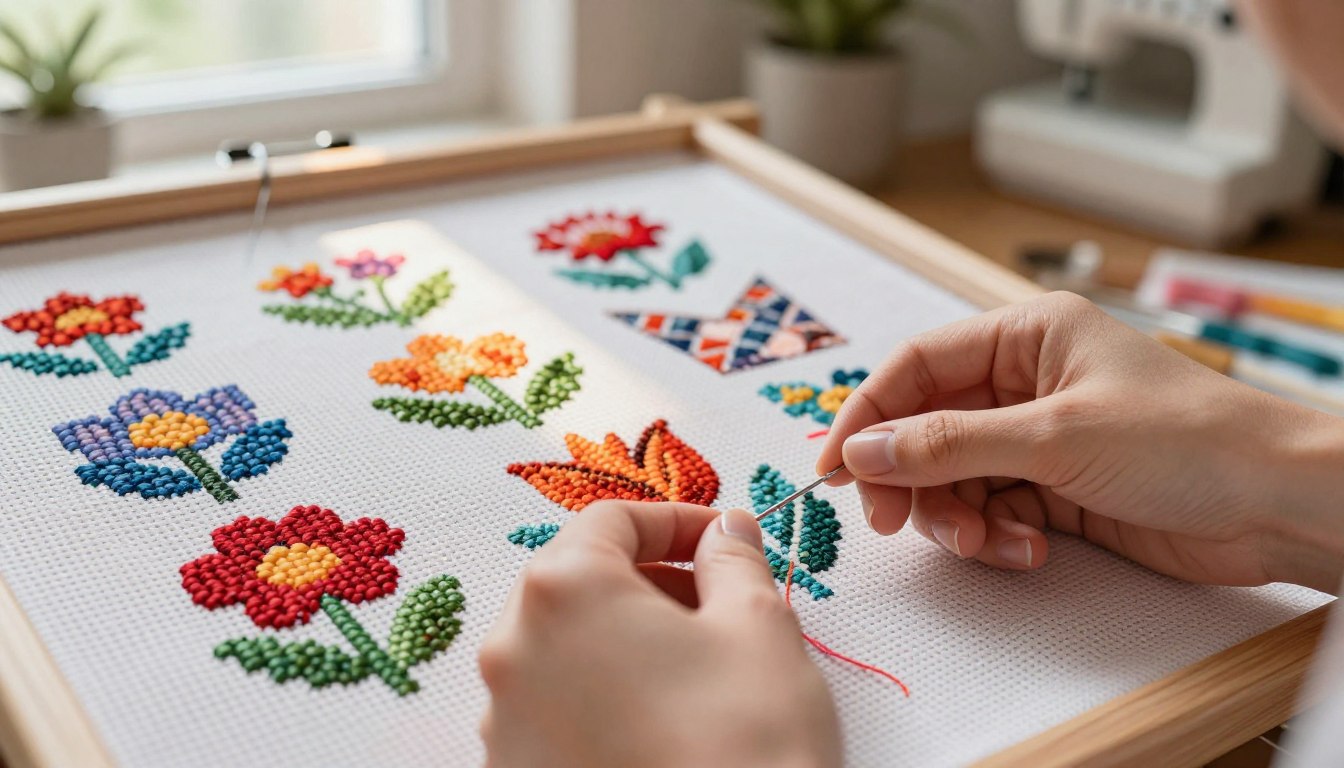
You’re about to learn how CROSS STITCH fits into a larger family of needlework. It’s often the first choice for new stitchers. Cross stitch uses X-shaped stitches on Aida or evenweave fabric to create tiled, geometric designs. This clear grid makes it easy to follow, and many beginners start projects from the center to keep alignment steady.
Embroidery is the umbrella term that includes both cross stitch and needlepoint. Understanding cross stitch vs embroidery helps you see why some techniques call for a flexible fabric and many stitch types. Cross stitch, however, stays focused on precise X stitches.
When you compare cross stitch vs needlepoint, note that needlepoint is worked on a stiffer canvas. It often covers the surface with varied stitches and textures rather than repeating Xs.
Counted cross stitch patterns require you to count threads and place each X according to a chart. Stamped or printed kits instead give you a marked design on the fabric. Cross stitch for beginners often means small, flat items like bookmarks, coasters, and simple wall art. These projects teach basic cross stitch techniques without a big investment in supplies.
Key Takeaways
- CROSS STITCH is a form of embroidery using X-shaped stitches on Aida or evenweave fabric.
- Counted cross stitch relies on charts; stamped kits show the design directly on fabric.
- Embroidery is broader, while cross stitch vs needlepoint differs mainly by fabric and stitch variety.
- Needlepoint uses a stiff canvas and more stitch types and textures than cross stitch.
- Cross stitch for beginners suits small, flat projects and straightforward cross stitch techniques.
CROSS STITCH: What it Is and Why Beginners Love It
Cross stitch is a simple embroidery style that uses X-shaped stitches. It creates clear, pixelated images. It’s easy to learn because it uses one main stitch and a grid.
Stitched kits have the design printed on the fabric for easy guidance. Counted patterns offer more control and variety.
Definition and core technique
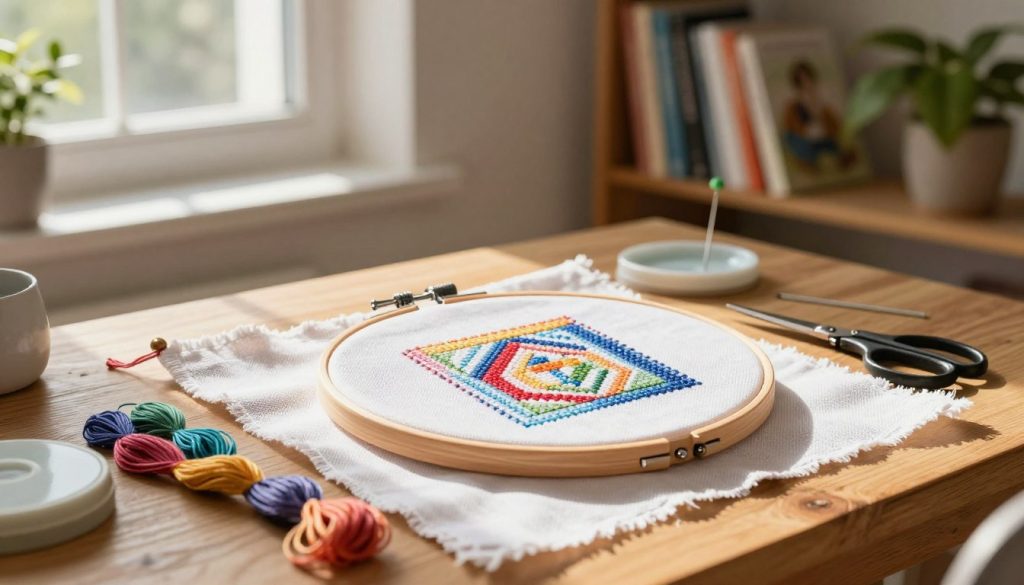
Counted cross stitch follows a chart and counts fabric squares from the center. Each X represents one square. You work in rows or blocks, which speeds up projects and keeps tension even.
Backstitching techniques are used later to outline details. This sharpens faces, letters, and edges.
Typical materials and tools
Start with Aida cloth for its even weave. Use cotton embroidery floss, like DMC, which is easy to find. You’ll need an embroidery hoop, tapestry needles, scissors, gridding tools or a wash-away pen, and a thread and pattern organizer.
Common project types and ideas
Projects with a boxy, pixel-like look work well. Try wall hangings, bookmarks, coasters, small pillows, or samplers with slogans. Start with simple designs and larger-count fabric to practice steady stitching and backstitching.
Beginner tips and common mistakes
Begin with clear, simple designs and larger-count fabric. Label your DMC floss and grid before starting. Work large blocks of the same color to save time and keep tension even.
Common mistakes include miscounting, inconsistent tension, and not securing thread ends. Use cross stitch tips like starting from the center and finishing threads cleanly to avoid rework.
Embroidery: The Broader Art and How It Differs
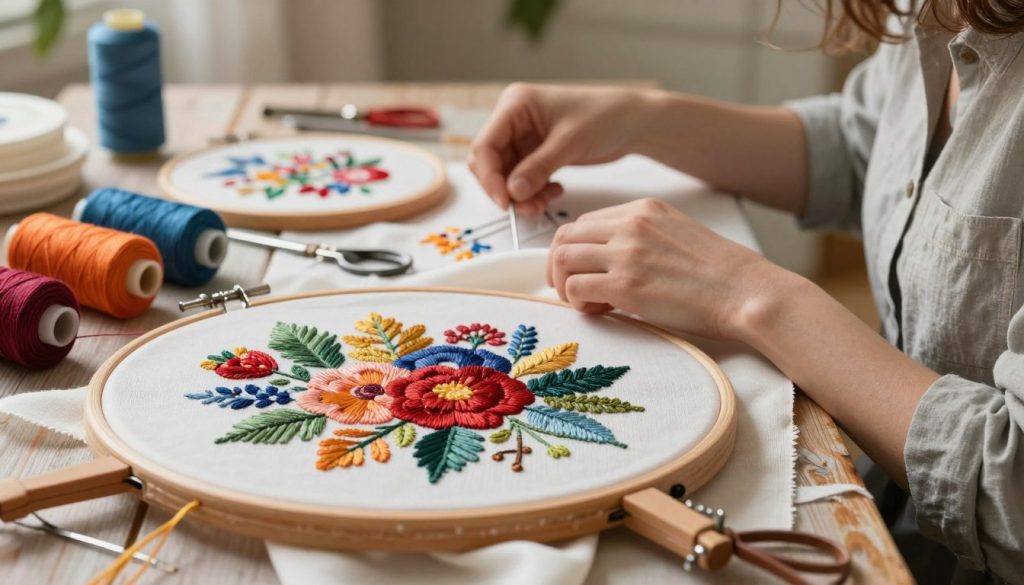
Embroidery is the art of decorating fabric with needle and thread. It includes many techniques, from freehand hand embroidery to precise machine embroidery. You can use it on garments, home linens, or mixed-media art to add texture and personality.
Here’s how embroidery compares to cross stitch and needlepoint.
Embroidery defined and how it relates to needlepoint and cross stitch
Embroidery is a broad term for many needle arts. Cross stitch and needlepoint fall under it when a grid or canvas guides the work. Embroidery offers more freedom in shape and line than grid-based methods.
Common stitches and embellishments
Stitch variety makes embroidery exciting. Simple lines like the running stitch and backstitch build outlines and movement.
French knot creates tiny dots and texture. Chain stitch, stem stitch, and satin stitch let you create shading and filled areas. You can add beads, sequins, and specialty threads to raise the visual impact.
Materials, tools, and formats
Your toolkit overlaps with other needle arts. You will often use embroidery hoops to keep fabric taut, needles, and floss or thread. Choose fabrics that suit your goal: lightweight cottons for garments, linen for heirloom pieces, or stabilizers when doing machine embroidery.
Hand embroidery rewards slow, tactile work and allows small imperfections to become part of the charm. Machine embroidery gives fast, repeatable results for gifts and small-batch production.
When to choose embroidery over cross stitch or needlepoint
Choose embroidery when you want organic shapes, detailed shading, or varied texture. Pick hand embroidery for craft therapy, personalization, and expressive detail.
Select machine embroidery when you need speed and consistency for items like towels, pillows, or apparel. If a project needs strict geometry and a counted pattern, cross stitch or needlepoint may fit better.
| Use Case | Best Technique | Key Tools | Why Choose It |
|---|---|---|---|
| Personalized gift with unique texture | Hand embroidery | Embroidery hoops, needles, floss | Expressive marks, small variations add charm |
| Branded items or repeatable designs | Machine embroidery | Stabilizers, embroidery machine, digitized files | Fast, consistent, professional finish |
| Grid-based pattern with pixel look | Cross stitch | Aida fabric, tapestry needles, stranded thread | Predictable, simple counting, strong graphic effect |
| Durable canvas items like cushions | Needlepoint | Canvas, wool yarns, tapestry needle | Heavy-duty texture, dense coverage, longevity |
Needlepoint: Canvas Work, Stitch Variety, and Durability
Needlepoint is a craft that uses stitches to cover canvas. It makes durable, textured surfaces for both functional items and framed art. You work on a stiff or woven mesh, often on a stitch-painted canvas. This keeps designs accurate as you add layers of color and texture.
This craft is different from cross stitch in technique and material. It helps you avoid common mistakes like underestimating thread weight or tension.
What needlepoint is and how it’s worked
You start by mounting the canvas on stretcher bars to keep it flat. Then, you follow a painted guide or chart while filling holes with yarns or threads. Basic rhythm is about consistent tension and neat thread starts and ends.
This keeps the back tidy and the front evenly covered.
Characteristic stitches and stitch libraries
Core stitches include tent stitch, continental stitch, and basketweave stitch for solid coverage. You can add Parisian, Gobelin, and Mosaic stitches for texture and movement. Advanced stitch libraries list Rhodes, Byzantine, and Herringbone for decorative fills.
Turkey Work is used for pile effects.
Canvas, yarns, and material choices
Needlepoint canvas comes in different counts and mesh types. Choose a larger mesh for thick yarns and a fine mesh for silk or metallics. Tapestry wool and mercerized cotton are common for durability and color depth.
When planning a high-wear item, match fiber strength to use. Stronger threads protect the canvas and extend its life.
Tools and preparation differences
Needlepoint tools include blunt tapestry needles, stretcher bars, and a selection of threads. You will likely use specialized needles and thread conditioners for long passes. For last-minute fixes, learn compensation techniques for shaped areas.
Consult stitch charts to ensure seamless joins.
How to Choose Between Cross Stitch, Embroidery, and Needlepoint for Your Next Project
Choose a technique that matches your project’s look and your available time. Cross stitch is great for pixel-like designs on pillows, gifts, and wall art. Embroidery is best for adding flair to clothes and creating varied textures. Needlepoint is perfect for durable items like belts and chair panels due to its strength and depth.
Match your goal to the technique
For bright, flat motifs, go with counted or stamped cross stitch. It’s ideal for clear patterns. For organic lines and beads, embroidery offers richer textures. Needlepoint is best for three-dimensional textures, especially on canvas with wool or silk threads.
Skill level, time, and learning curve
Cross stitch is beginner-friendly. You can learn the X-stitch quickly and start simple projects in a weekend. Embroidery needs more practice for advanced fills but has easy starter stitches. Needlepoint requires patience and a wide range of stitches; start with lessons like Needlepoint.com’s Level 1–4.
Materials budget and sourcing
Cross-stitch supplies are affordable. You can find Aida fabric, DMC floss, needles, and hoops at Michaels or Joann. Embroidery might cost more with silk or metallic threads, but cotton sets are budget-friendly. Needlepoint can be more expensive; expect to spend on stretcher bars, specialty canvases, and wool yarns from shops like Elizabeth Bradley Designs or Needlepoint To Go.
Tips to get started and organize your projects
Begin with a small cross stitch kit to learn tension and backstitch. For embroidery, start with a sampler to practice various stitches. Needlepoint beginners should begin with a printed canvas and practice tent and continental stitches.
Use cross stitch gridding and wash-away markers for large designs. Label floss bobbins, store threads in boxes, and plan your projects. Use hoops or frames for even tension on cross-stitch and embroidery, and stretcher bars for needlepoint to avoid distortion.
Stitching can be therapeutic. Set small, regular time blocks for your projects. Track common mistakes like skipped gridding or mismatched counts early to avoid extra work. Practice tension control and stitch direction to improve your stitching.
Conclusion
Each technique has its own purpose. Cross stitch is great for graphic designs and quick projects. It’s easy to learn and can help reduce stress.
Basic tools like a needle, hoop, scissors, and floss are essential. They help you move smoothly through your projects.
Embroidery is more versatile. It uses various stitches to add texture to different fabrics. It’s perfect for creating unique, wearable art.
Needlepoint is known for its durability and variety. It’s worked on canvas with yarn or wool. This technique creates sturdy, textured pieces.
Choose needlepoint for projects that need to last. Be prepared to work with thicker materials and special canvases.
Decide based on your goals, time, and budget. Start small and practice basic stitches. Needlework has a long history and is still a popular craft today.
 English