Have you ever wondered if a single stitch can speak as clearly as a sentence?
Embroidery is decorative stitching done on cloth with a needle. It includes techniques like needlepoint and cross-stitch. Merriam‑Webster says embroidery also means embellishment in speech, showing how thread art can convey meaning.
This article explores how embroidery works like written language. You’ll learn how creative needlework tells stories, shows identity, and makes arguments through stitch choices and material. Whether you’re into textile art or just curious, this comparison will inspire your projects.
Here’s a clear guide: stitches are like words, and composition is like grammar. We’ll look at historical parallels, like samplers and political textiles, and compare stitching techniques. You’ll also see how contemporary artists use embroidery to tell stories and get practical tips for your own projects.
Key Takeaways
- Embroidery is more than decoration; it can communicate ideas like written language.
- Thread art includes many stitching types, each acting like a different vocabulary.
- Historical samplers and political cloth show how needlework records identity and history.
- Comparing techniques such as needlepoint and cross-stitch reveals different narrative tools.
- This article will give practical and conceptual links to help you apply storytelling to your creative needlework.
How embroidery tells stories: stitch as sentence
You read a stitched panel like a paragraph. Each mark and thread choice tells a story. In embroidery, the needle speaks to us.
Stitch choices as vocabulary
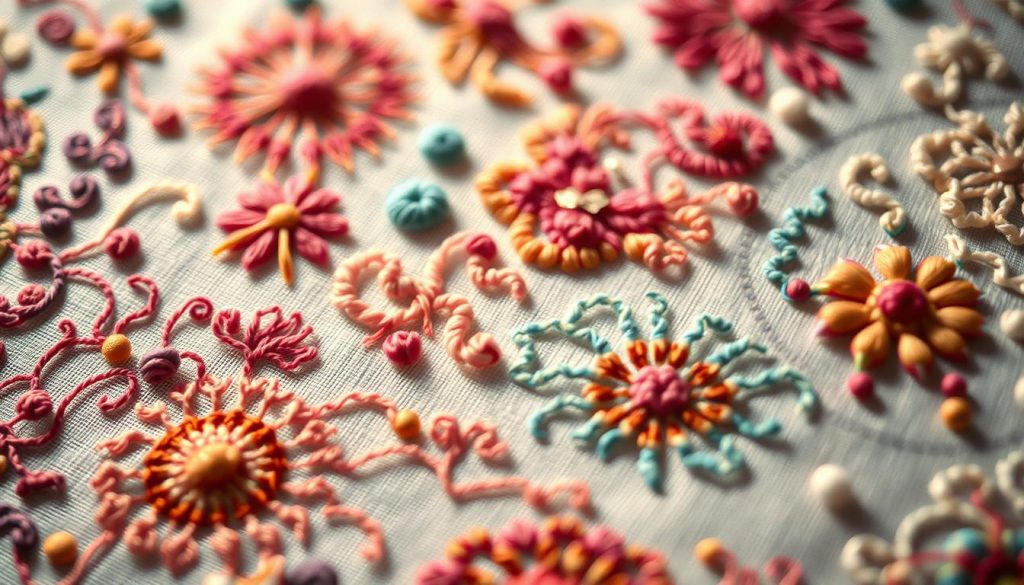
Chain stitch, tambour, and cross-stitch are like words. Chain and tambour create flowing lines, perfect for flowers. Cross-stitch breaks images into small, letter-like pieces, telling stories or showing alphabets.
Tent stitch gives a tight, tapestry feel, great for cushions. Needlepoint, crewelwork, and tambour are like different voices in speech. Some stitches sound formal, while others are more casual.
Needle techniques change how we see a scene. Your choice of stitches can make a big difference.
Composition and grammar in textile art
Motifs are like sentences. Borders and empty space act as paragraph breaks. Repeats set the rhythm, and scale controls the pace.
Long tapestries tell stories in sequence. They guide the viewer through time. Layering and using different stitches together add depth and interest.
Curators at museums arrange displays to guide viewers. They show how composition affects our reading of thread art.
Tone, voice, and color palette
Color and thread weight shape the voice of your work. Bright, bold colors can feel dramatic or intimate. Simple colors can seem playful or serious.
Using metallic threads adds formality. Thick wool makes a piece feel personal. You can make your work ironic, lyrical, or instructive by mixing motifs, typography, and color.
Historical context is important. Cultural views on needlework affect how we hear the voice in your work.
Historical parallels between needlework and written language
The stitched page has a long history. You can trace literacy in fabric through schoolroom samplers, political textiles, and museum records that treat needlework as text.
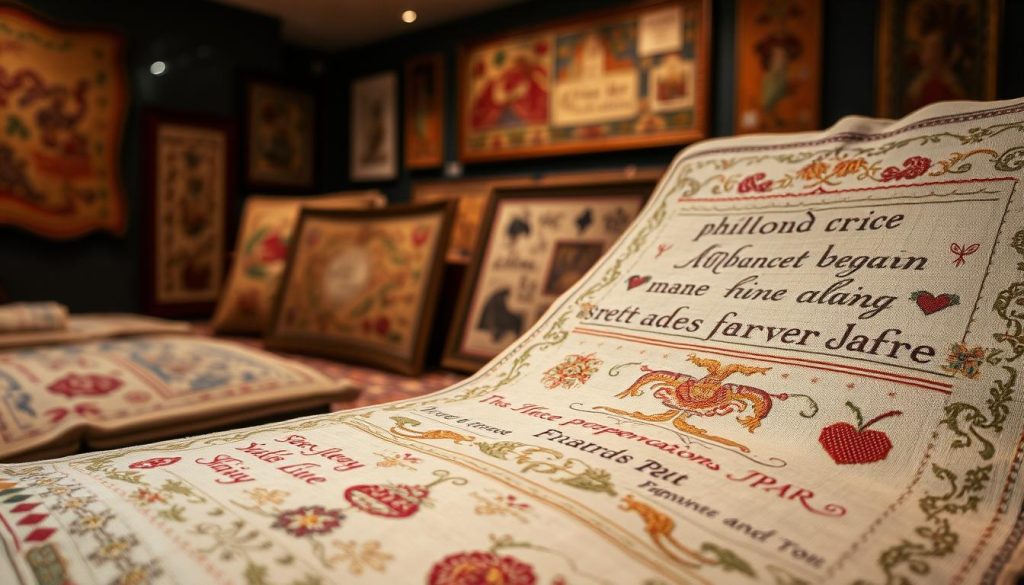
Samplers started as basic exercises in the 17th and 18th centuries. Girls learned cross stitch alphabets, numerals, and short couplets. Museum examples like Maria Lalor’s (1793) and Almira Holmes’ (1821) show how makers practiced letters and recorded names and ages.
These stitched exercises trained you in household skills and in reading textile marks. Some samplers include pictorial scenes and original designs. These works show clear compositional skill, like prose or verse on cloth.
Needlework has served political and cultural aims across continents. Ottoman embroideries offered symbolic protection for religious objects and infants. In Chile, arpilleras of the 1970s and 1980s memorialized disappeared family members during Pinochet’s regime and became acts of resistance.
Feminist artists reclaimed stitch as a political medium in the 1970s and 1980s. Judy Chicago, Miriam Schapiro, and Faith Ringgold used embroidery to challenge hierarchies. Rozsika Parker’s scholarship argued that the subversive stitch helped construct and contest femininity in culture and history.
Museums and archives preserve this narrative quality. Collections at the Metropolitan Museum of Art and the Museum of Arts and Design document tent stitch settees from the early 1700s. They describe techniques like cross stitch and tambour work in historic inventories.
Curatorial records and diaries, including notes by Mrs. Anna Larpent, mention tent stitch, cross stitch, and everyday mending. Archives in Colonial America show embroidery used for genealogy and family records. This reveals how stitched items functioned as both practical objects and personal histories.
Contemporary exhibitions and scholarship continue to reframe embroidered objects as narrative artifacts. Curators highlight works by artists such as Britta Marakatt-Labba. They show how textile pieces operate as political texts and lived memory.
If you’re comparing techniques, think about needlepoint vs embroidery and the craft differences that shape meaning. An embroidery comparison reveals how cross stitch grids read differently from tent stitch canvases. These craft choices affect narrative clarity.
Comparing techniques: needlepoint vs embroidery and other stitching types
Looking at different stitching types shows how they carry meaning. Needlepoint vs embroidery is a key question. It helps you pick the right materials, tools, and approach for your project. This section offers a clear comparison to help you see the differences and choose what suits your project.
Needlepoint is done on canvas with stitches that cover the whole area. You get dense, strong surfaces with stitches like tent, continental, or basketweave. Needlepoint is great for upholstery and cushions where you need a solid surface.
Embroidery uses many needle techniques. It includes free-stitch decoration like crewel, chain, and tambour, and counted-thread work like cross stitch. Embroidery can be detailed or bold, depending on the stitch and thread you use.
For a hands-on look at embroidery, compare machine and hand work. Artists and conservators say hand work adds a special touch that machines can’t match. If you want to express yourself through your stitches, hand embroidery is the way to go.
Cross stitch and samplers use a grid system. Each X represents a cell, making it easy to create motifs and alphabets. Samplers were used to practice and teach, showing off alphabets and household marks.
The grid system is like a writing system. You build stories by arranging motifs, initials, and numbers. Cross stitch and samplers are great for clear images or text.
Thread techniques add meaning beyond just images. Tambour or Aari threads show luxury and skill. The choice of silk or cotton, thin threads or heavy yarn, and adding beads sends messages about status and intent.
Materials can tell a story. Palestinian tatreez patterns show village origins. Dindga McCannon’s beadwork and Natalie Baxter’s quilting use thread and embellishments to talk about identity and nationhood.
Use this comparison to guide your design. Choose needlepoint for coverage and structure. Go for embroidery or cross stitch for gesture, text-like grids, or symbolic thread work. Your stitching choices are part of the message you weave into fabric.
Modern practice: contemporary artists and your creative needlework
Contemporary embroidery ranges from small samplers to big public art. Artists use thread to share personal stories, social views, and cultural tales. This new approach encourages you to explore your own needlework.
Artists who stitch narratives
Sophia Narrett uses thread to tell stories in domestic scenes. Orly Cogan combines old linens with new figures to question identity. Jordan Nassar reworks tatreez to link family history and place.
Britta Marakatt-Labba’s tapestry tells Sámi history over generations. Elaine Reichek weaves words into cloth, making arguments visible. These artists show embroidery’s power to share life stories, politics, and memories.
Tech, scale, and mixed media approaches
Artists create from small pieces to large installations. Elsa Maria Meléndez builds immersive scenes. Marakatt-Labba’s tapestries tell stories over long distances.
Mixed media is common, blending painting, beading, and more with stitching. Some artists digitize patterns before stitching, connecting textiles and technology. This mix broadens what we call embroidery today.
Practical tips for storytelling in your projects
Choose stitches that express your voice. Chain or tambour for flowing lines. Cross-stitch for detailed scenes. Satin and tent stitches for soft fills.
Plan your composition like a story. Set a main point, then add supporting scenes. Use borders to mark chapters. Negative space and contrast add depth, like in writing.
Color is key, setting mood and volume. Artists blend colors with thread art. Add text for clear messages. Small pieces are personal; large ones engage the public.
| Aspect | Typical Use | Effect on Narrative |
|---|---|---|
| Stitch choice | Chain, satin, cross-stitch, tambour | Shapes voice, pace, and literal versus painterly reading |
| Scale | Sampler to installation | Private intimacy versus public statement |
| Mixed media | Painting, beading, digital prints, appliqué | Layered meaning and material contrast |
| Text integration | Hand lettering, stitched slogans | Direct voice; clarifies or complicates visual message |
| Digital tools | Pattern generation, printing aids | Speeds design; bridges craft and code |
Conclusion
Embroidery is like writing, with stitches as words and composition as grammar. Color and material add tone and voice. Museum pieces and studies show how embroidery tells stories of personal and public life.
Today, artists like Sophia Narrett and Jordan Nassar use embroidery to share messages and critiques. They show that needlework can be powerful and expressive.
When you work on a project, think like a writer. Choose your stitches, layout, and materials with purpose. This turns your needlework into a story or a statement.
Think of your hoop as a page. Use stitches to convey meaning, composition to structure your message, and colors to set the mood. Learn from history and modern artists to guide your work. Then, try new things and let your art speak for itself.
 English