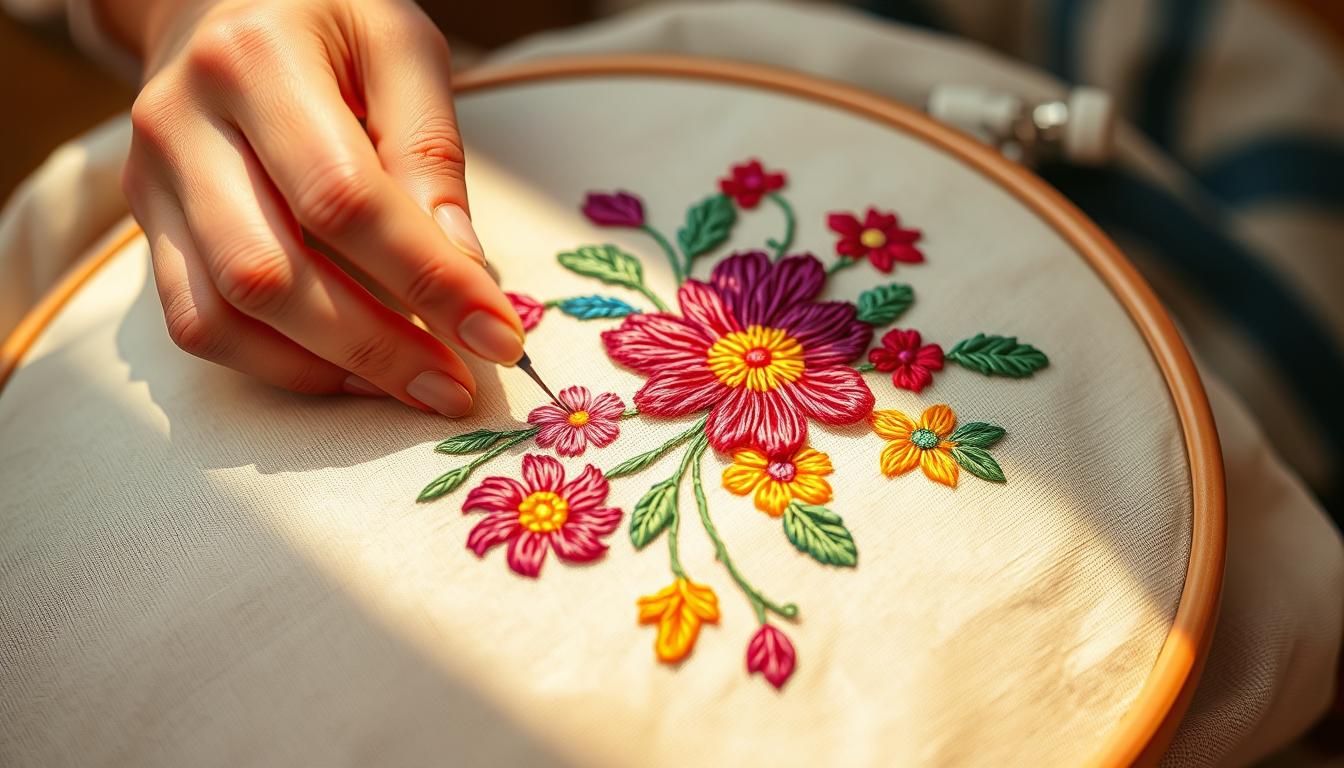
Can a handful of simple tools and a few practiced stitches turn you into a confident stitcher faster than you think?
Embroidery is enjoying a clear revival. You don’t need years of experience to join it. With basic supplies like an embroidery hoop, sharp scissors, and DMC floss, you can start making beautiful pieces right away.
Start with a 5″–6″ hoop for steady tension and portability. Cut your fabric slightly larger than the hoop. Loosen the screw, fit the inner hoop under the fabric, and press the outer hoop on top. Pull the fabric taut like a drum and tighten the screw without over-stressing the fibers.
For beginners, use a short thread length and split floss to adjust thickness. Choose chenille or embroidery needles based on texture and detail. Transfer a simple pattern with a water-soluble marker and practice core stitches. Basic stitches will let you finish charming samplers and small projects quickly.
Care for your finished pieces by hand washing and line drying. Avoid ironing directly over stitches. Consider a backing like felt or iron-on for garments. Mounting or framing stretches and presents your work professionally, preserving your efforts in this once-dying craft that’s now thriving again.
Key Takeaways
- Start simple: a 5″–6″ hoop, DMC floss, and a few needles are enough to begin.
- Use small, taut hoop tension and move it across fabric for larger designs.
- Keep thread lengths about arm’s length and split six-strand floss to vary thickness.
- Transfer patterns with a water-soluble marker and practice core stitches first.
- Hand wash and line dry finished work; use backing for wearable pieces.
- Framing or mounting improves presentation and longevity of your needlework.
Getting started with embroidery: must-have supplies and tools
To start with embroidery, you need some basic things. You’ll need a comfy place to work, good lighting, and a starter kit. This kit should have fabric, thread, needles, and an embroidery hoop. Having the right tools makes learning easier and faster.

Essential tools to begin
Choose an embroidery hoop that feels right in your hand. A 5″–6″ hoop is great for beginners. It keeps the fabric tight and moves smoothly over designs.
Choose fabrics that are easy to work with. Linen, quilting cotton, and muslin are good choices. Avoid fabrics that are too loose or too tight.
For thread, DMC floss is a reliable choice. It has consistent color and texture. Use six-strand floss and split it as needed. Keep thread lengths short to avoid tangles.
For needles, a chenille needle is good for beginners. It has a large eye for easy threading. Keep a small set of needles for detailed work.
Other tools help you stay organized. Sharp embroidery scissors, a water-soluble marker, and tracing supplies are useful. They make transferring patterns easy and clean.
Preparation and setup
Cut your fabric 2–3 inches larger than your hoop. Place the inner hoop under the fabric, then the outer hoop on top. Tighten the screw and stretch the fabric until it’s tight.
Check the fabric tension often. It should be tight enough for neat stitches but not too tight. If working on a big design, use a small hoop to move across the pattern.
Consider starter kits or video lessons for guided practice. Many stores sell beginner kits with everything you need. These kits help build your confidence.
For finished pieces, use a felt backing or iron-on interfacing. These protect the embroidery and keep it looking good when framing or adding to clothes.
Basic stitches and techniques to learn quickly
Start with a few reliable hand embroidery techniques. They will give you control and confidence. Practice each stitch slowly on a sampler to build muscle memory and keep your work tidy.
Keep your thread length short. Use the splitting floss trick to vary texture and thickness.
Core stitches every beginner should master
The running stitch is simple for layout, framing, and airy fills. Work even spacing with a basic up-and-down method to keep rows neat.
Use backstitch for crisp outlines and lettering. Make your needle exit at the hole left by the previous stitch to keep the back neat and save floss. A slight variation gives a cleaner reverse for embroidery pieces.
Practice split stitch to add raised texture to shapes like tree tops or floral frosting. Keep stitches short, about 1/8″–1/4″, and come up through the center of the prior stitch for a braided look.
Try stem stitch on flowing lines and vines. Small rice-grain-length stitches, brought up beside the last stitch on the same side, create a twisted rope effect that suits stems and curves.
Satin stitch fills shapes and letters. You can outline then fill, stitch satin on its own, or backstitch first and satin over for a subtle rise. Keep stitches close to the edge and avoid carrying thread across the back to prevent bulk.
Use French knot for tiny raised dots. Wrap the floss one to three times around the needle, hold taut, then insert the needle close to where it came up. Pull through carefully and tie off between spaced knots to stop trailing tails.
Thread handling and needle techniques
Control thread length to avoid tangles. Aim for 50–80 cm, with about 8 cm left when you finish a length so ends are easier to secure. Shorter lengths reduce fray and knotting.
For fine detail, split floss into one or two strands. For bolder fills use four to six strands. Splitting floss lets you match the stitch to the scale of the design without changing needles.
Use a wet-tip trick to ease threading when the end frays. Choose chenille needles for thick, multi-strand work and sharp embroidery needles for neat French knots. Stop and rewind your thread often; practice hundreds of simple repeats to make the motions automatic.
Practical tips, troubleshooting, and time-saving tricks
Keep your workspace simple and steady for better stitch quality. Use a 5″–6″ hoop for most handwork. Move a small hoop across larger designs to keep consistent hoop tension. Proper tension control prevents puckering fabric and makes stitches sit cleanly.
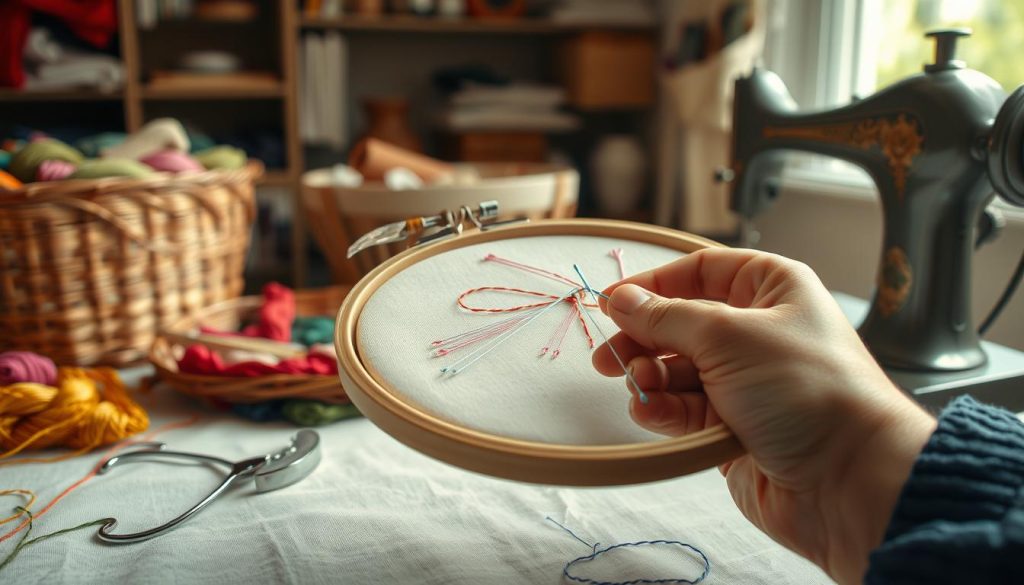
Cut thread to about arm’s length. Shorter lengths tangle less and make finishing ends easier. Don’t double floss like sewing; thread once and leave a short tail when you start. This reduces messy embroidery backs and saves time.
Top tips from experienced stitchers
Work with the right needle. Chenille needles ease threading for thicker threads. Use embroidery needles for fine details and neater French knots. For French knot troubleshooting, wrap the floss one to three times and practice on scrap fabric to control size.
Keep a small pair of sharp scissors at hand to trim loose tails as you go. When stitching across a large area, move the hoop instead of stretching fabric across a huge frame. This preserves hoop tension and improves overall stitch placement.
Protect colors when washing. If you see thread dye run, hand wash in cold water and rinse until the water runs clear. Use a color catcher in the rinse water when you’re unsure about a new floss brand.
Troubleshooting common problems
If you notice puckering fabric, loosen your hoop tension slightly and re-seat the fabric so it lies flat. Check your tension control on each stitch; pulling too tight on satin stitch causes visible dimples.
For messy embroidery backs, avoid carrying threads across open areas on light fabric. End threads close to the work and tuck or knot them under nearby stitches. Trim stray ends before framing or mounting.
When gold or specialty threads tangle or fray, slow down and use shorter lengths. Expect some extra effort with metallics. Look for dedicated tutorials from brands like DMC or Kreinik when you want deeper technique notes.
Adopt small, practical time-saving embroidery tricks: group similar colors, pre-cut threads to uniform lengths, and keep a tidy kit. These habits reduce setup time and let you spend more of your session stitching.
Embracing tradition and modernity: styles, patterns, and projects
Blending old techniques with new ideas can teach a lot. Start by trying classic motifs to grasp stitch structure. This lets you move from simple samplers to more complex pieces, keeping traditional embroidery alive.
Try drawing your own pattern on fabric with a water-soluble marker, or use iron-on transfers and carbon paper for accuracy. Shops like Sublime Stitching and Etsy offer beginner kits, hoops, and patterns. These make practicing easy. Small experiments boost confidence and support the embroidery revival.
You can frame a finished piece in a hoop or mount it on canvas to show texture and stitch volume. Hoop art is a quick way to display work as decor and show progress. Mounting lifts embroidery culture into gallery-style presentation, giving fragile stitches a stronger visual voice.
Beginner-friendly projects include tea towels, embroidered patches, and simple wearable embroidery like collar accents or back-pocket motifs. These items teach finishing techniques such as backing with felt or iron-on stabilizers. Wearable pieces help you practice durability without heavy investment.
Look for modern embroidery trends that favor minimal lines, bold single motifs, and mixed-media touches. Pair hand-stitched letters with appliqué or add simple florals to denim. Contemporary makers are pushing what counts as craft, and you can follow them on Instagram or local Eat Drink Stitch events to find community feedback.
If you want guided progress, follow step-by-step tutorials to stitch flowers, letters, and small motifs with basic techniques. Transfer patterns to fabrics suited to each stitch and finish by stretching and framing to elevate each piece. This practice keeps heritage crafts visible while fueling the continuing interest in a craft once called a dying craft.
Use short projects to join online groups and swap tips. You will pick up time-saving tricks and discover supplies at CreateForLess and Etsy that match your budget. These connections help sustain the embroidery revival and plant you inside a living embroidery culture.
Conclusion
Embroidery is easy and fun to learn. Start with basic stitches like the running stitch and satin stitch. Use photos and tutorials to improve your skills.
Practice until your stitches feel natural. Remember, the right tools like thread length and needles matter a lot for beginners.
Stitches don’t have to be perfect to be beautiful. You can fix mistakes and care for your work. Try new things like letters and appliqué to grow your skills.
Be practical when embroidering. Use the right needles and keep threads short. View embroidery as a skill you can always improve. It’s part of a bigger movement to celebrate embroidery culture.
With patience and practice, you’ll become better at needlework. It will become a fun and lasting hobby for you.
 English